Two plows leave the same yard with the same grade of insert and run the same route; one is built with trapezoid inserts, the other with bullnose. At the end of the season the bullnose edge has kept its cutting line on the hardpack sections and the trapezoid edge has worn evenly across the whole width, but neither result is a surprise once you look at how each shape meets the road.
The difference between the two geometries is not a quality difference; it is a difference in where the load goes and how the insert fails. This comparison works through the contact pattern, the cutting and crushing actions, the wear each shape produces, how each behaves under impact, and the practical question of what to do when both could work.
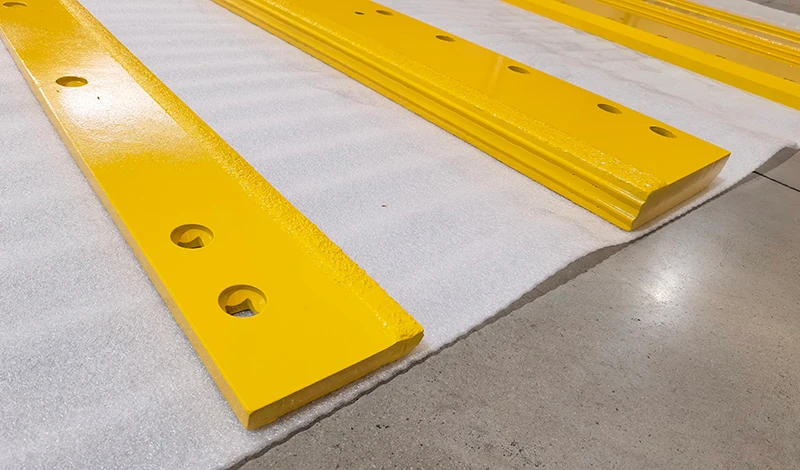
Trapezoid inserts: how each geometry contacts the surface
Contact area decides everything that follows.
A trapezoid insert presents a wide flat face to the road and tapers back into its pocket, so the contact is a broad band rather than a point. A bullnose insert presents a rounded crown, so contact starts as a narrow line and widens only as the insert wears or as down pressure increases.
The same machine, running the same down pressure, therefore applies very different contact stress through the two shapes.
Two consequences follow directly. The broad face of a trapezoid spreads load and reduces the pressure at any one point, which is what keeps an edge from cutting into pavement. The crown of a bullnose concentrates that same load into a small area, which is what allows an edge to break the bond between ice and a road surface. Neither is an accident of manufacturing; each is the point of the shape.
Cutting versus crushing action
The two geometries are built around two different ways of removing a surface layer, and the difference shows up in what the driver feels as much as in what the edge wears.
- A trapezoid insert scrapes: the broad face rides a plane and removes material by abrasion across the full width of contact.
- A bullnose insert penetrates: the crown concentrates force until bonded material fractures and releases ahead of the insert.
- Mix the two on one edge and the machine does both at once, which is why the mixed pattern is worth considering rather than dismissing.
Which action suits a route is settled by what is on the road rather than by preference. Loose snow and dry pavement reward scraping, because there is nothing to fracture and the priority is keeping the contact even. Bonded ice, packed snow and the polished hardpack that forms at intersections reward penetration, because the bond has to be broken before it can be cleared.
Wear pattern differences
Each geometry wears into a different shape, and that shape is what determines how long the edge keeps working before it needs attention. A trapezoid insert wears down across its flat face, so it shortens while roughly maintaining its profile; the contact area grows slightly as it wears, which keeps the load spread and keeps the rate of change predictable.
A bullnose insert wears at the crown first. As the crown flattens, the contact area grows, pressure falls, and the edge gradually stops penetrating as effectively as it did when new. The insert is not worn out at that point, but its cutting action has changed, which is why bullnose edges are usually judged on cutting performance rather than on remaining insert height. The measurement that matters differs between the two shapes, and a fleet that inspects both the same way will misjudge one of them.
Retention behaviour under impact
Impact is where the two geometries separate most sharply, and the reason is mechanical rather than metallurgical.
- A trapezoid insert is supported by the walls of a matching pocket, so a shock load is carried into the steel around it and into the joint below.
- A bullnose insert sits proud with less lateral support, so an impact arrives with more leverage at its base than the same impact applied to a broader shape.
- Neither shape is safer in every case: the trapezoid transmits more impact into the assembly, and the bullnose concentrates more of it at the insert.
The practical reading is that a route with regular raised ironwork puts more demand on retention whichever shape is fitted, and the answer lies in the retention method rather than in the geometry. The two methods and how each one fails are compared on the insert retention page.
Application fit by surface type
Surface type is the clearest predictor of which geometry will perform, and it is worth writing into the specification rather than leaving to the supplier.
| Surface or duty | Leading geometry | Reason |
|---|---|---|
| Bonded ice and packed snow | Bullnose | Concentrated pressure breaks the bond ahead of the insert |
| Chip seal, gravel, abrasive pavement | Trapezoid | Broad contact spreads load and carries steady abrasion |
| Highway plowing at speed | Trapezoid, tougher grade at the ends | Contact area keeps the edge off the pavement at higher loads |
| Urban routes with ironwork | Either, with retention specified for impact | Geometry matters less than surviving the shock load |
| Mixed route with ice sections | Both, sectioned along the width | Contact requirements change within a single route |
The fifth row is the case fleets most often get wrong, because it is decided by the worst section of the route rather than by the average one. Specifying the whole edge for the ice sections leaves the abrasive sections under-protected, and specifying for abrasion leaves the ice untreated.
Replacement and rotation practice
Rotation and replacement practice differ between the two shapes, and running the same routine on both wastes material. The sequence below keeps the two patterns distinct.
- Measure the dimension that reflects wear for that shape: height for trapezoid inserts, profile loss at the crown for bullnose.
- Rotate the edge between positions only where the wear distribution justifies it, since a bullnose edge that has lost its crown will not recover it by moving.
- Replace inserts in full rows rather than singly, because a mixed-age row loads its newest member hardest.
- Record the geometry fitted at each position, so the next season’s inspection compares like with like.
The third step matters more than it looks. A single new insert set between worn neighbours ends up standing proud, taking the impact first and wearing faster than the row around it, which is how a workshop ends up replacing the same insert twice in a season.
Choosing when both could work
Where a route contains both bonded material and abrasive surface, the decision usually comes down to how the edge is sectioned rather than to which single shape is better. The method that works is to map the route by surface, not by kilometre: identify the sections that consistently produce hardpack or ice, and specify those positions with the shape that penetrates.
Two practical constraints govern how far that split can go. The first is the pocket: a blade body cut for one insert profile cannot accept the other without rework, so the mix has to be decided when the edge is ordered rather than when it is serviced. The second is the spares list, since carrying two insert shapes costs more than carrying one and only pays if the mix is stable across seasons. Where the surface varies too much to map, a single geometry with a grade chosen for the worst case is usually the more honest specification.
Insert geometry on grader and bucket edges
The same two families appear on grader blades and loader bucket edges, and here the balance shifts. Grader work is dominated by controlled abrasion along a road surface, which favours the broad contact of a trapezoid insert and rewards geometries that keep the cutting line straight as they wear.
Bucket edges meet stockpiles and mixed material at unpredictable angles, so the load arrives from directions a plow edge never sees. A shape with more lateral support tolerates that better, and the retention method matters more here than on a plow, because the impact can arrive from the side as well as from the front. The grade and spacing decisions that sit alongside geometry are set out on the grade, size and spacing page.
Mixing geometries along one edge
A mixed edge is workable, and it is worth doing properly rather than arriving at by accident. The rule that keeps it reliable is that the mix is defined by position: state which positions along the edge carry which shape, and hold that layout constant through every replacement.
The failure mode to avoid is a storekeeper in a hurry fitting whichever insert fits the pocket. Where the two profiles are close enough to interchange, that is a real risk, and the mitigation is to make the difference visible: different part numbers, separate bins, and a drawing that shows the layout rather than describing it. Dimensions and patterns of this kind are documented against the conventions published by ISO, and test methods for the material on both sides of the insert are published by ASTM International.
SENTHAI manufactures tungsten carbide inserts in both families and carbide plow edges in Rayong, Thailand, with the geometry confirmed against the surface the edge will work. Equipment standards that constrain what a blade assembly may be fitted to are maintained by SAE International, and brazing practice for the joints that hold these inserts is published by the American Welding Society. Fleet-level practice for winter maintenance programmes is published by the Snow and Ice Management Association.
Where the surface mix is genuinely variable, sending the route description and the wear pattern from the previous season is more useful than choosing a shape from a catalogue, and the sheet is described on the carbide snow plow blade page. Enquiries that need a geometry confirmed against a specific machine can be sent through the contact page.
FAQ
Are trapezoid inserts better than bullnose inserts?
Neither is better in general. Trapezoid inserts present a broad face to the road and suit abrasive surfaces where the priority is carrying wear. Bullnose inserts concentrate pressure at a smaller contact point and suit bonded ice and hardpack. The route decides, not the shape.
Can you mix trapezoid and bullnose inserts on one edge?
You can, and on a route with a shifting surface it is often worth doing. The requirement is that the mix is planned and drawn, so the replacement pattern stays the same between batches and a storekeeper cannot fit the wrong shape into a pocket that was cut for the other.
Which insert shape lasts longer?
The one whose contact pattern matches the surface. Bullnose inserts wear at the crown and go out of profile first on abrasive pavement; trapezoid inserts wear across a broad face and lose cutting edge first on hardpack. Each shape lasts longer than the other on the surface it was designed for.
Send the route surfaces, the insert profile currently fitted and the wear pattern from last season. The SENTHAI engineering desk will confirm which geometry suits the duty and where a mixed layout is worth specifying.
This article is one step in the Carbide Insert Selection and Replacement Guide, which covers grade, geometry, spacing, fitment tolerance and the replace-or-re-plate call.