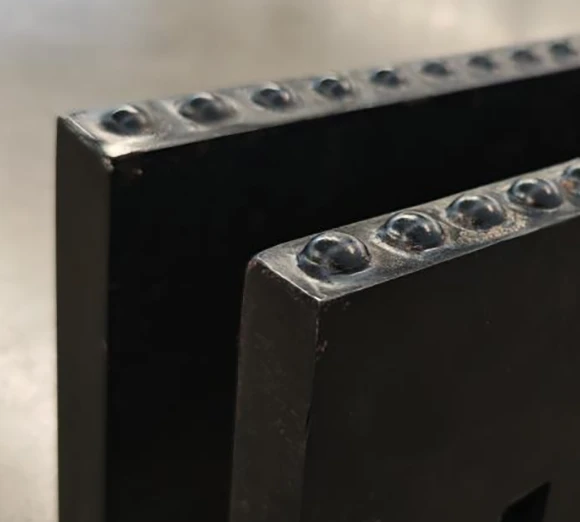
A route that has been plowed all week still shows a polished white surface at every intersection, and the edge that has been over it every day is worn flat along its whole width rather than gouged or chipped. Nothing has failed. The blade has been riding the hardpack instead of cutting it, and the wear pattern is the record of that.
An isolated edge system changes what happens at the contact point rather than the force the machine can apply. This guide works through how the arrangement of inserts produces cutting action on bonded material, what it demands from the carrier and the route, and the conditions under which it is the wrong tool.
Packed ice carbide kit: why standard edges polish instead of cut
Flat edges polish bonded material instead of cutting it.
A steel or clad edge presents a flat face to the road, so the available down force is divided across the whole working width. On loose snow that is what is wanted: the edge clears without cutting into the pavement. On bonded material, the same distribution gives any one point too little pressure to break the bond.
The edge then slides across the top of it instead of cutting it away.
What the surface does under that treatment is worth understanding, because it explains the wear pattern. The polished layer is not the absence of ice; it is ice that has been smoothed by repeated passes and had its high points removed. It becomes harder and smoother each time it is ridden over, which is why a route that looks clear after a pass can be the most difficult surface of the week by the following morning. What that does to a standard edge over a season is described on the packed ice damage page.
Construction of an isolated insert system
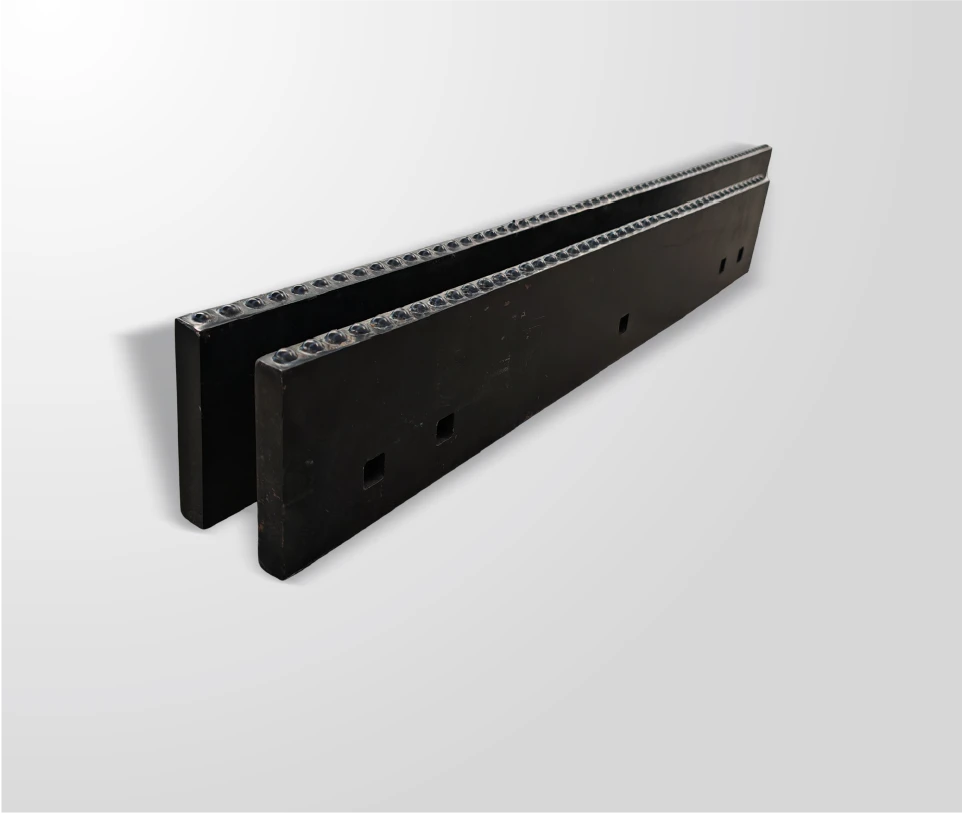
An isolated edge system changes the geometry of contact rather than the material of the blade. Instead of a continuous cutting strip, the edge carries separately mounted carbide inserts that stand proud of the body, each presenting its own small contact area to the road.
Three construction details make that arrangement work. The inserts are held so that each one carries its own load rather than sharing a strip, which means the retention has to suit a component that takes repeated point loading. The body is built to keep the inserts at a consistent height along the working width, because a single low insert stops cutting and a single high one takes the entire impact of a transition. And the assembly is designed so that an insert can be replaced without disturbing its neighbours, which is what keeps the edge in service across a season of hardpack work.
The result is a cutting line that behaves as a series of tools rather than as a scraper. That is the whole of the mechanism: nothing about the machine’s weight changes, and nothing about the down force changes. What changes is how much of that force arrives at each point of contact.
Contact pressure per insert
Contact pressure is the variable that decides whether an edge cuts or rides, and it is set by dividing the available force across the contact area. The table below shows how the two arrangements compare on that basis for the same machine and the same down force.
| Arrangement | Contact area at the road | Effect on bonded material |
|---|---|---|
| Continuous steel or clad edge | Full working width | Load too distributed to break the bond; the edge rides |
| Isolated inserts at wide spacing | Several small points | Pressure rises enough to fracture hardpack at each point |
| Isolated inserts at close spacing | Many small points, nearer to a line | Cutting action with less separation between contacts |
| Worn inserts, reduced height | Small points at a shallow angle | Pressure falls away and the edge returns to polishing |
The last row is the mechanism behind a common complaint about these systems after a season of work. As insert height reduces, the contact geometry changes, and an edge that cut hardpack in December can be polishing it by February without anything having broken.
Blade angle and down pressure
Two settings decide whether the available force reaches the insert or is spent somewhere else. Blade angle governs how the insert meets the surface; too shallow and the insert scrapes along the top of the material, too steep and the force goes into pushing the blade rather than into the contact point. The usable range is narrow on hardpack and wider on loose snow, which is why the setting is worth recording per route rather than per fleet.
Down pressure is the second half. An isolated edge concentrates the pressure available, but it cannot create pressure that the carrier does not supply. Where a machine can float its blade or cannot hold a consistent load, the contact pressure at each insert varies along the route and the cutting action becomes intermittent. How those settings interact on a working machine, and how to read them from the operator’s position, is set out on the down pressure and blade angle page.
Speed limits for effective cutting
Speed works against cutting, because contact time at each insert falls as the machine travels faster. The insert still arrives at the surface; it simply does not stay there long enough to fracture the bond and release the material.
What that means in practice is that the effective operating range on hardpack sits at the lower end of what a route allows, and the operator’s instinct to finish a long route quickly works against the tool. The relationship is not linear: as speed rises, the edge moves through a transition from cutting to riding, and past that point the result is the same as a standard edge at a higher rate of wear. For a route where the hardpack is thin and broken up, the higher end of the range is usable, and where it is thick and continuous, it is not.
Surface types that respond well
The system responds to bonded material and does not respond to loose material, and knowing which is which on a route is what makes a trial meaningful.
- Bonded hardpack at intersections and on shaded sections, where traffic has compressed snow into ice.
- The polished layer that forms on treated surfaces after repeated freeze-thaw cycles.
- Wind-packed snow that has consolidated to the point where a scraper rides over it.
- Tracked ice at junctions where vehicles have stopped and restarted through a freeze.
The common property is that the material has a bond to the surface beneath it. Loose or recently fallen snow does not, and an isolated edge on loose material behaves like a narrower edge: it clears and casts it, without any of the cutting benefit the system was specified for. The insert arrangement that suits this work is described on the carbide inserts page.
Maintenance of the insert array
Maintenance on an isolated edge is about keeping the array uniform rather than keeping it sharp. Cemented carbide does not sharpen in service and does not need to; what it needs is for every position along the edge to present the same contact to the road.
Two practices keep that condition. Inserts are replaced in rows rather than singly, because a new insert beside worn neighbours stands proud, takes the transition impacts and wears faster than the array around it. And insert height is measured at each service rather than judged by eye, because the change that ends cutting action is gradual and looks unremarkable at any single inspection. The measurement itself is straightforward and takes minutes per edge.
Matching the kit to the carrier
The decision that matters before purchase is whether the carrier can deliver what the system needs, and it comes down to three questions that can be answered from a specification sheet and one observation.
Can the blade hold a consistent cutting line, or does it float? Can down pressure be adjusted and held, or is it fixed? And does the mounting pattern accept the edge geometry without modification? The observation is the simpler test: on a route the fleet knows well, does a standard edge ride over the hardpack or cut into it? Where it already cuts, the surface does not need this system, and where it polishes, the carrier is a candidate.
What the system changes about route practice
An isolated edge changes the operating window on a route, and the change is worth planning for rather than discovering. The effective speed range narrows on hardpack, which means routes with heavy bonded sections take longer. Contact pressure per insert is higher, which means the surface is cut rather than scraped and the treated layer is broken up rather than polished.
The operational consequence is that the ice-control response changes: where a route previously needed repeated passes with chemical assistance, the same route may respond to fewer, slower passes with the cutting edge doing the work. Whether that trade is worth making is a route-level question rather than a fleet-level one, and it is the question the payback case is built on.
Where the system is not the answer
The system has limits, and stating them is more useful than repeating what it does well.
- Where the hardpack is thin and regularly broken up by traffic, a standard edge clears it and the extra cost is not recovered.
- Where the carrier cannot hold down pressure, the inserts cannot develop the contact they need.
- Where the route runs at high speed over bare pavement, the arrangement offers nothing a conventional edge does not.
- Where an operator cannot work at the lower end of the speed range on bonded sections, the tool reverts to scraping.
The second and fourth entries are the ones fleets underestimate. Both are about the operating envelope rather than the product, and both decide the outcome more than the specification does.
How a kit is specified and ordered
The specification that makes a kit repeatable has five parts: the working width and the insert arrangement across it, the insert profile and dimensions, the grade direction with the duty it was chosen for, the mounting pattern and its tolerance, and the documentation that travels with the lot.
Two further items belong in the order for the fleet’s own benefit. State the surface and route condition the arrangement was chosen for, so a later review knows what it was matched to. And require the delivered lot to be identified against that specification, so a comparison between two seasons compares two known things. Published guidance on how winter conditions affect a network is available from the Federal Highway Administration and its road weather programme, and equipment standards from SAE International.
SENTHAI manufactures packed ice carbide kits, inserts and plow edges in Rayong, Thailand, with the insert arrangement and grade confirmed against the surface the edge will work. Test methods behind the material values are published by ASTM International and the classification conventions by ISO, and kits that need the arrangement matched to a specific carrier can be discussed through the contact page.
FAQ
What is a packed ice carbide kit?
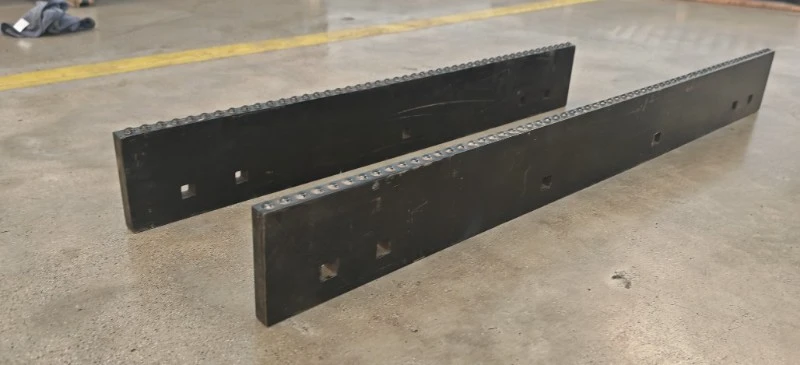
It is a cutting edge built around separately mounted carbide inserts that stand proud of the blade body, so the road contact happens at a series of small, hard points instead of along a continuous steel strip. The arrangement concentrates down pressure at each contact, which is what allows the edge to break bonded hardpack rather than ride over it.
Does an isolated carbide edge need a different carrier?
It needs a carrier that can hold a consistent cutting line and supply enough down pressure. A machine whose blade floats over the surface or whose down pressure is limited will not develop the contact pressure the system relies on, and the inserts then polish the hardpack as a standard edge would. The requirement is a match, not necessarily a different machine.
How fast can you run a packed ice edge?
Speed works against cutting, because contact time at each insert falls as the machine moves faster. Where the hardpack is thick or bonded, the effective range is at the lower end of what the route allows, and pushing speed up converts a cutting edge back into a scraping one. The usable range depends on the layer, not on the blade.
Send the carrier, the working width and the surface the route presents after a freeze-thaw cycle. The SENTHAI engineering desk will confirm the insert arrangement, grade and mounting pattern for the machine.
This article is one step in the Packed Ice Edge Guide, which explains why a standard edge skates across hardpack and how to set one up so it bites.