Two routes in the same city see the same storm and the same freeze. One is cut while the surface is still yielding, and the work is finished with a single pass and a light treatment; the other waits for the forecast to clear, and the same route takes three passes, two treatments and a call-out over the following two days. Neither fleet worked harder than the other. One of them worked before the material had a chance to bond.
This is a decision path for that timing choice. It covers how the layer forms, what the second cycle actually costs, the conditions that should trigger early cutting, how the equipment and the treatment have to be arranged around it, and how to build the routine into shift planning rather than leaving it to judgement at three in the morning.
Packed ice prevention: how layers form
A layer forms in stages, each harder to undo than the last.
It begins with snow or slush on the surface. Traffic compacts it, which removes the air and leaves a denser material than the snow that fell.
If the temperature then falls, that compacted material bonds to the pavement and to itself, and what remains is the dense, hard layer that a conventional edge rides rather than cuts. Once the sequence has run, removing the layer means breaking a bond rather than moving loose material.
Prevention targets the first two stages. Material that is removed before it is compacted never reaches the density that makes it durable, and material that is removed before the freeze never forms the bond at all.
The cost of waiting one cycle
The difference between the first cycle and the second is not a matter of degree; it is a different job. In the first cycle the route is being cleared, and a blade with a conventional edge does most of the work. In the second it is being cut, which requires contact pressure concentrated enough to break a bond, a lower operating speed, and often more than one pass over the same section.
Three costs accumulate from that difference. More passes over the same route, because the material does not move on the first one. More treatment, because the layer is not responsive to chemicals once it has set. And more of the work lands outside normal hours, because the second cycle is usually discovered after the freeze rather than before it.
The trade is visible in the route records of any fleet that has run both approaches. Where the same route has been worked early in one season and late in another, the difference in return visits is larger than the difference in initial effort, and it is the return visits that carry the labour, the treatment and the exposure.
Trigger conditions for early cutting
Early cutting needs a trigger rather than a judgement call, because the decision usually has to be made when nobody wants to make it.
- A forecast freeze following snow or slush, where the surface will not yield after the temperature drops.
- Traffic building on an untreated surface, which is what compacts the material into a layer.
- A falling temperature crossing the point at which the surface stops deforming under the blade.
- A route with the locations that hold ice first, which gives an early indication on part of the network.
The fourth entry is the most useful in practice. A fleet that has mapped its intersections, decks and shaded sections can use them as an early-warning indicator: when those locations are starting to hold material, the rest of the route will follow within hours, and the decision to cut early no longer depends on a forecast alone.
Equipment positioning before the freeze
Prevention fails more often on positioning than on willingness. A crew that decides to cut early and finds the carrier at the wrong end of the network has lost the window before it starts, because the window is measured in hours and the travel time is part of it.
Two arrangements address that. Carriers are staged before a forecast freeze rather than after it, so the route can be worked from whichever end the conditions allow. And the cutting arrangement on the carrier is set for the surface it is likely to meet, since a blade configured for loose snow is not the tool for a layer that is already forming. How those settings are chosen is set out on the down pressure and blade angle page.
Coordination with chemical treatment
Cutting and treatment work in sequence, and the sequence matters more than the quantities. Cutting first removes the bulk of the material and leaves a surface that treatment can affect; treating first on a thick layer tends to produce a wet surface that refreezes into something harder than what was there before.
Where the route is cut before it bonds, the treatment needed afterwards is usually smaller, because its job has changed from softening a layer to preventing an immediate refreeze. That is the origin of most of the saving in a prevention programme, and it shows up in the materials record rather than in the pass count.
Measuring success over a season
A prevention programme has to be measured on what it removes rather than on what it adds, because it always adds a pass at the front end. Four records carry the comparison: passes per storm, treatments per storm, return visits per storm, and out-of-hours call-outs per storm.
Comparing those four against a season of the previous approach is what produces a defensible result. Measuring passes alone hides the effect entirely, since an early-cut route usually works one more pass per storm and several fewer return visits, and the two do not carry the same cost. The wider payback framework for this kind of comparison is set out on the packed ice payback page.
Building the routine into shift planning
The routine survives only if it is written into the shift plan rather than left to the supervisor on duty.
- Add the freeze forecast to the shift briefing, so the trigger condition is visible before the shift starts.
- Stage carriers at the ends of the routes that hold ice first, before the temperature falls.
- Set the cutting arrangement for the surface expected, rather than leaving it set for the previous storm.
- Record the decision and the time it was taken, so the programme has a starting point for the season’s comparison.
The fourth step is what makes the programme improvable. A fleet that records when it cut and what followed can establish its own trigger thresholds over a season or two; one that works from memory re-argues the decision every storm. Guidance on how winter conditions develop across a network is published by the Federal Highway Administration and the Transportation Research Board.
What defeats an early-cutting programme
Three conditions defeat prevention, and none of them is about equipment.
- A trigger that depends on someone noticing, rather than on a forecast and a threshold.
- Carriers staged in the wrong place, so the window closes during travel to the route.
- Measurement that counts passes only, which makes the programme look like extra work with no return.
The third is the most damaging over time, because it is what turns a working programme into one that is dropped after a season. A fleet that tracks return visits and call-outs alongside passes sees the effect immediately and keeps the routine; one that tracks only passes concludes that prevention is additional work and reverts to reacting after the freeze.
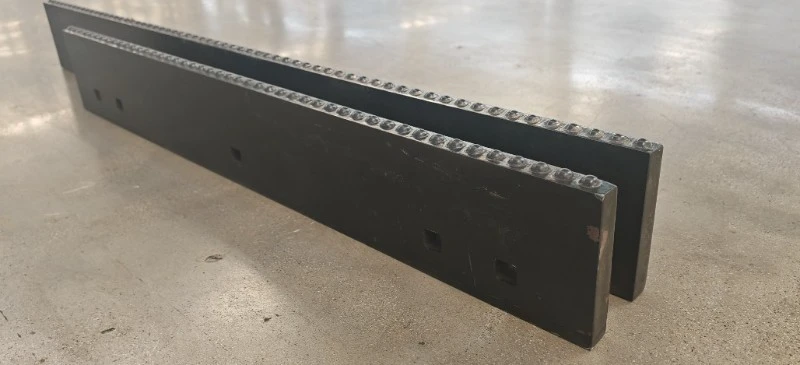
Where prevention fails and a layer does form, the tactics change by location, and those are set out on the packed ice tactics page. SENTHAI manufactures packed ice carbide kits, inserts and cutting edges in Rayong, Thailand, with the arrangement and grade confirmed against the surface a route produces. Fleet-level winter operations practice is published by the Snow and Ice Management Association, network-level practice by the Federal Highway Administration, and cost context by the American Association of State Highway and Transportation Officials. Routes that need equipment set up for early cutting can be discussed through the contact page.
FAQ
How do you prevent packed ice forming on a road?
By removing the material before it bonds rather than after. That means cutting while the surface is still soft enough to yield, before traffic compacts it and before the next freeze sets it. Prevention is a timing decision rather than a materials decision, and the timing window is measured in hours.
Why does waiting one cycle matter so much?
Because the second cycle is not the same job as the first. Material that has been compacted by traffic and refrozen is denser and more durable, and it needs more passes, more treatment and a cutting edge rather than a blade. One cycle of waiting converts a clearing job into a removal job.
What conditions should trigger early cutting?
A forecast freeze after snow or slush, traffic building on an untreated surface, and a temperature that is falling towards the point where the surface will stop yielding. Any one of those is enough to justify working the route ahead of schedule rather than after the freeze.
How does early cutting fit with chemical treatment?
They work in sequence rather than as alternatives. Cutting early removes the bulk and leaves a surface that treatment can work on; treating first on a thick layer often produces a wet surface that refreezes into a harder one. Where a route is cut before it bonds, less treatment is needed to hold it.
How do you measure whether prevention is working?
Count the events that follow. A programme is working when the number of return visits, treatments and out-of-hours call-outs per storm falls while the number of initial passes stays broadly the same. Measuring passes alone hides the effect, because prevention usually adds a pass and removes several.
Send the route list, the locations that hold ice first and the carriers available. The SENTHAI engineering desk will confirm the cutting arrangement that suits early work on those surfaces.
This article is one step in the Packed Ice Edge Guide, which explains why a standard edge skates across hardpack and how to set one up so it bites.