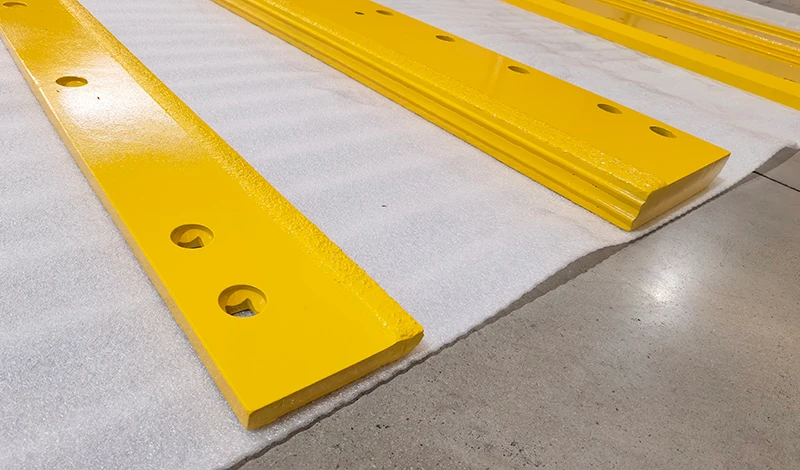
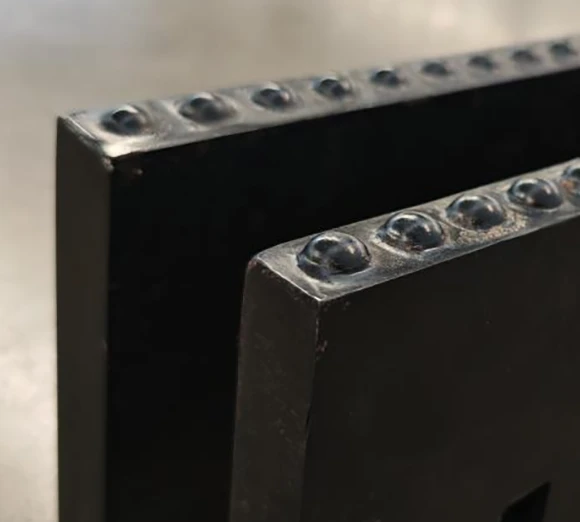
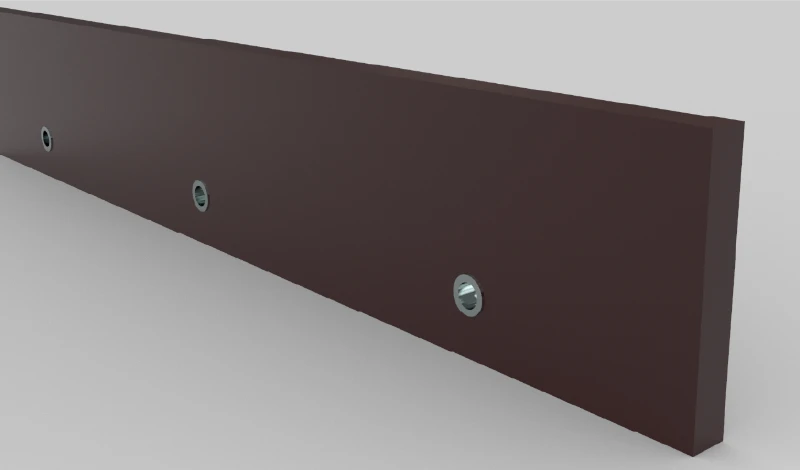
A cutting edge is ordered with two numbers: a length and a thickness. Buyers who fix one without the other usually order twice, because the length decides whether the blade clears the tyre track and the thickness decides whether it survives the duty the machine is given.
This guide treats sizing as a checklist rather than a catalogue lookup: width rules first, then duty, then the carrier class, and finally the moldboard and mounting that tie the two together. The sizing table at the end is the summary, but the sections before it are what make the table usable.
Blade width versus vehicle width rules
Match blade length to vehicle width and thickness to duty.
Blade length is bounded by the vehicle, not by the blade catalogue: the edge has to clear the tyre track while staying inside the width the truck can legally and safely carry with the plow mounted.
The usable width starts from the machine. A blade narrower than the truck leaves strips the wheels then pack, which costs a second pass. A blade much wider than the truck adds side load, steering effort and stress on the mounting, and in most jurisdictions the practical ceiling is the legal vehicle width, beyond which the blade becomes a permit question rather than a specification question.
Vehicle and attachment manufacturers publish the mounting and ballast limits for their machines, and equipment manufacturers are the practical reference for those constraints (Association of Equipment Manufacturers). Treat the legal width as the outer boundary and the machine’s rating as the working limit.
Thickness thresholds by plowing duty
Thickness follows duty. A section that is right for occasional yard work will deflect and wear quickly under continuous highway scraping, while a heavy edge on a light seasonal route adds weight and cost without adding life.
Duty is defined by four things: the surface mix, the speed, the hours per season and the down-pressure the mount applies. A route that mixes gravel and asphalt at low speed loads the edge differently from a chip-seal highway run, even when the machines are the same class. Because the load cases differ, a fleet that runs one section thickness across every route is averaging two requirements rather than standardising on one.
The practical threshold test for a buyer is to compare the fleet’s own failure record: if edges bend or crack before the carbide wears, the section is too thin for the duty; if the carbide always wears out first and the carrier is intact, the thickness is adequate and the grade or insert spacing is the next thing to change. Where a specification references a highway standard for edge and bolt patterns, the published standards work of AASHTO is the usual reference point in North America.
Independent research on winter maintenance practice and equipment selection is collected by the Transportation Research Board, and is a reasonable source when a specification is being rewritten after a season that produced more changeouts than expected.
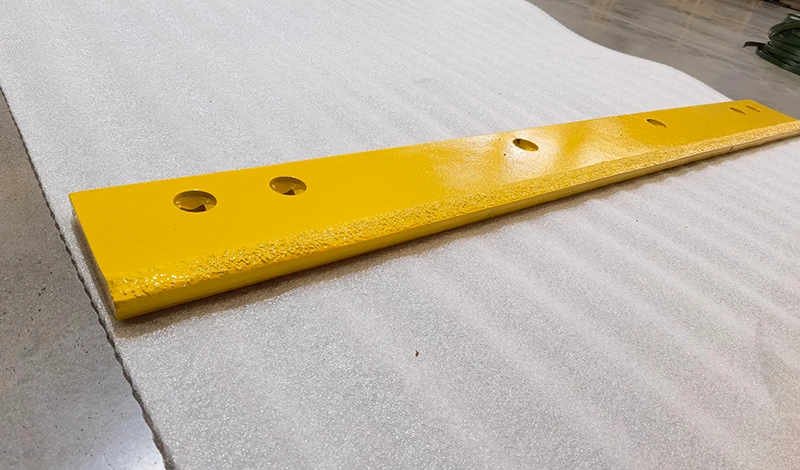
Half-ton, three-quarter-ton and one-ton carriers
The light truck classes are where oversizing does the most damage. A half-ton pickup can run a straight blade for driveways, small lots and residential routes, but the front-axle capacity, ballast and mounting rating set a ceiling that a longer blade will exceed in use even if it bolts on successfully.
A three-quarter-ton truck is the usual step for longer residential and light commercial routes, and a one-ton chassis is where municipal light-duty work begins in many fleets. In every case the two decisions are linked: a longer blade weighs more and shifts more weight onto the front axle, so the sizing conversation has to include the ballast or counterweight that keeps the machine stable.
For a buyer assembling a mixed fleet, the useful discipline is to fix the blade class per chassis rather than per route. Matching one blade family to a three-quarter-ton class keeps the mountings, fasteners and spare edges interchangeable across every truck of that class, which is where the saving is.
Medium-duty and heavy municipal chassis
Medium-duty and heavy chassis are bought on duty cycle rather than on convenience. These are the units that run the arterial and highway routes, where a shift can cover hundreds of lane kilometres at speed and the edge is expected to survive until a planned changeout.
Sizing here is dominated by three constraints: the width the chassis can carry at the speeds it runs, the down-pressure the hydraulic system can hold against hardpack, and the load the mounting frame can take without fatigue. Because these trucks are often on a multi-year cycle, the specification tends to be written once and repeated, which raises the value of a locked drawing and an archived batch record.
Fleet practice at this scale is documented by state transport agencies, and the maintenance programmes published by MnDOT and the route classification approach used by Colorado DOT both show how equipment is assigned by class rather than by individual unit.
Loaders, graders and tractors
Non-truck carriers change the sizing logic entirely, because they work at low speed with high down-pressure and often on unpaved ground. A loader pushing snow across a yard and a grader cutting a gravel road both load the edge vertically rather than through a plow frame at speed.
For these machines, length is set by the bucket, blade or moldboard they mount to, and thickness is set by how much weight and force the machine can apply. A compact tractor with a loader-mounted blade needs a section light enough that the loader can still control it, while a motor grader can carry a heavier edge because the machine is designed to hold a blade under load.
The edge material also shifts. On gravel, an impact-led carbide or a flex edge protects both the surface and the machine, whereas a hard edge on the same ground chips and digs. SENTHAI produces edges to a measured pattern for trucks, graders, loaders and skid steers, so mounting geometry is confirmed from the machine rather than assumed from the class.
How the moldboard affects blade choice
The moldboard is the part that actually throws the snow, and its geometry decides how much of the load reaches the cutting edge. A tall, curved moldboard rolls snow away at speed, while a short or flat blade pushes it, which changes both the side load and the scraping pressure the edge sustains.
Two practical consequences follow. First, the bolt line has to match the moldboard: the same edge section will not fit two different hole patterns, and redrilling on site is a weak substitute for a correct pattern. Second, the attack angle set by the moldboard and the mounting frame decides whether the edge scrapes cleanly or skips, so a change of blade style on the same truck may require the angle to be reset rather than assumed.
This is why a replacement edge order is most reliably placed from a drawing, a part number or a photographed mounting rather than from the previous edge alone; the previous edge may itself have been the wrong section for the board. The snow plow blade range sets out the families available once the pattern is confirmed.
Sizing table
Use the table as a checklist rather than a specification. It sets out what drives length and thickness in each carrier class and the constraint a buyer has to confirm before ordering.
| Carrier class | What sets length | What sets thickness | Confirm before ordering |
|---|---|---|---|
| Half-ton pickup | Width of the tyre track, within legal vehicle width | Light seasonal duty | Front-axle rating and ballast |
| Three-quarter-ton and one-ton | Route width and turning space | Mixed residential and light commercial duty | Mounting rating and counterweight |
| Medium-duty municipal | Arterial width and speed | Continuous seasonal duty | Hydraulic down-pressure and frame condition |
| Heavy highway chassis | Legal width at operating speed | High-abrasion highway duty | Carrier toughness and documented batch records |
| Loader, grader, tractor | Bucket, blade or moldboard width | Ground conditions and machine force | Edge material for gravel versus paved surfaces |
Where buyers oversize and undersize
Oversizing is the more common error, and it usually starts with a good intention. A buyer orders the widest blade the truck will accept and a thicker section for durability, then discovers that the extra weight has to be ballasted, the steering effort has risen and the truck is slower on the route that actually pays.
Undersizing shows up differently. A light blade on continuous duty wears quickly, deflects under down-pressure and ends the season with a bent carrier and a changeout schedule nobody planned. The tell is a fleet that replaces edges faster than the wear records suggest it should.
Both errors are avoided with the same discipline: write the route, the machine, the legal width and the measured duty into the specification, then let length and thickness follow from them. Where a first order is being assembled across several classes, distributor and wholesale programmes can supply a mixed set against one drawing pack, which keeps the patterns consistent (wholesale snow plow blades for distributors).
FAQ
How thick is a snow plow cutting edge?
There is no single figure, because thickness follows the machine and the duty rather than the blade name. Light seasonal work sits at the thin end of the range, high-duty highway work at the thick end, and a clad or two-layer edge adds its own cover thickness on top of the base section. Measure the edge you are replacing and confirm the figure against the mounting drawing before ordering.
What length snow plow blade fits a three-quarter-ton truck?
Length is set by the width the truck can carry legally and safely rather than by the truck class alone. A three-quarter-ton truck can physically carry a longer blade than a half-ton, but the front-axle capacity, ballast and mounting system decide the usable limit, and most jurisdictions cap a blade near the legal vehicle width. Confirm the truck and plow manufacturer limits, then specify the edge to that width.
Does blade length have to match the truck width?
It does not have to match exactly, but the relationship matters. A blade narrower than the truck leaves an uncleared strip the wheels then pack, while a much wider blade adds steering load and side stress that the front end may not be rated for. The practical target is a blade that clears the tyre track and stays inside the width the vehicle can legally and safely carry with the plow mounted.
How do I measure an existing blade before ordering a replacement?
Measure the edge length end to end, the section thickness, the hole diameter, the hole spacing from the first hole to the last, and the offset of the holes from the top and bottom edge. Photograph the mounting with a tape measure in frame. Those five measurements plus the machine model are usually enough for a supplier to confirm a pattern without a drawing, and they prevent an expensive guess.
Send the machine model, the route duty and the five measurements from the edge you are replacing. The SENTHAI engineering desk will confirm length, thickness, hole pattern and edge material, then quote the set as one order.