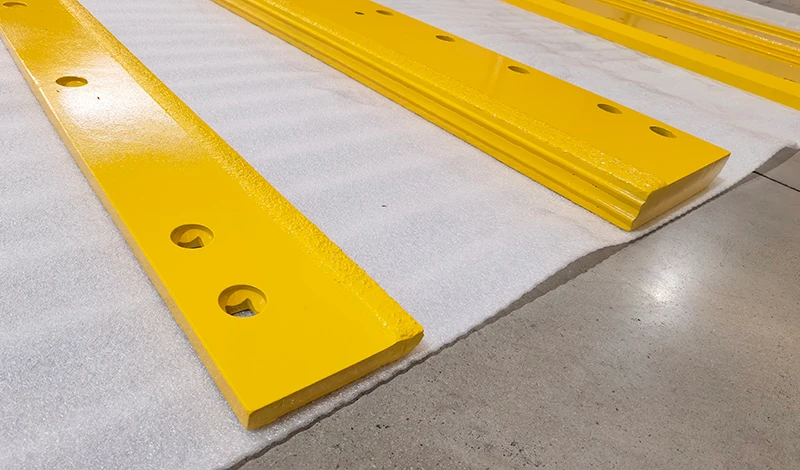
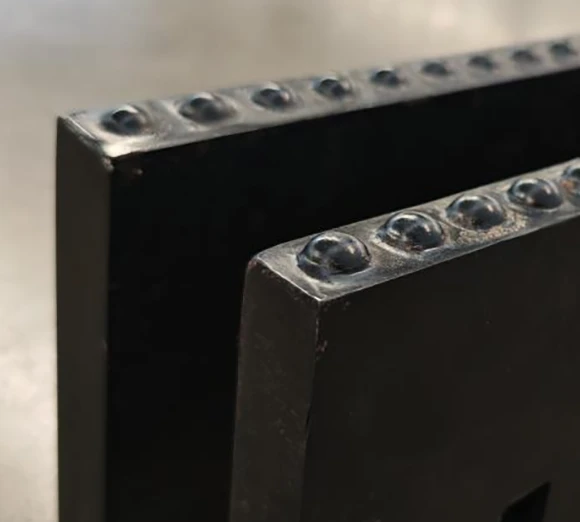
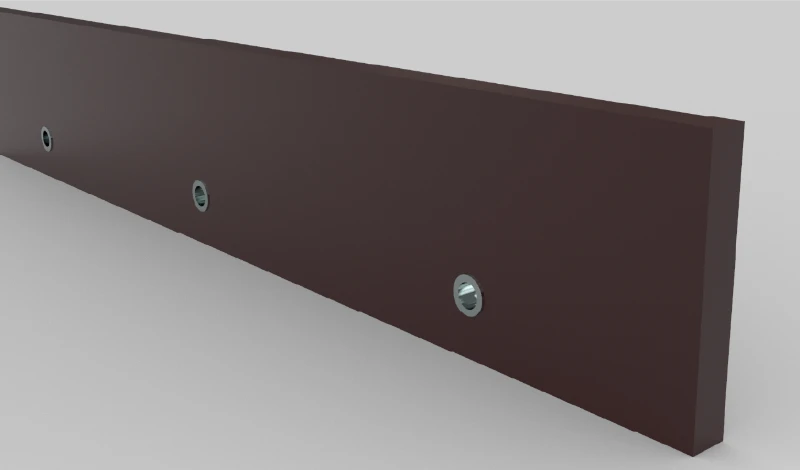
A truck leaves the shop with a new cutting edge and comes back three shifts later with that edge still sharp, two bolts missing, the shoes worn through and a wear plate bent. Nobody ordered the wrong blade. The system was treated as one part, when it is five parts with five different wear rates and five different inspection points.
This is the maintenance path through a snowplow blade system, in the order the parts tend to fail and in the order a spares list should be built.
Cutting edge, wear plate and shoe assembly
Five parts wear at different rates; the edge is only one.
A snowplow blade system is the cutting edge, the wear plate or cover that protects the carrier, the shoes or skids that set working height, the fasteners that hold the assembly together, and the moldboard, trip and controls that position it.
The cutting edge does the work and takes the abrasion, so it usually reaches its wear limit first. The shoes set the working height, and because they are small and cheap they are often left in service too long; a shoe that has worn below its setting lets the edge run deeper, which raises load, heat and wear on everything downstream. The wear plate or cover exists to protect the carrier and the moldboard structure, and it is the part most often omitted from a spares list until a job stops for it.
Read the three together rather than separately. A fleet that replaces edges on a schedule while ignoring shoes and covers is not maintaining a system; it is absorbing the consequences of one part’s failure in the others, which is where uneven wear and mid-season surprises come from. Guidance on surface protection and seasonal site practice for commercial and municipal crews is published by the Snow & Ice Management Association.
Fasteners, nuts and torque interfaces
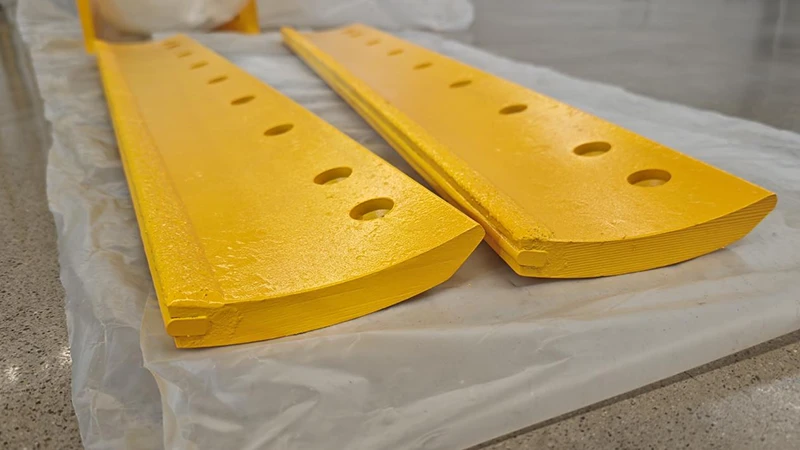
Fasteners are the least glamorous part of the system and the one that ends most shifts early. Every strike the edge takes is transferred into the bolt line, and a fastener that has lost clamp load will not announce itself until the edge shifts.
The failure sequence is predictable. A bolt loses torque, the joint moves slightly, the hole in the carrier elongates, and the next bolt takes more of the load. By the time a driver notices a rattle or a step in the clearing pattern, several fasteners are past their limit and the hole pattern may already be damaged beyond re-use.
The counter-measures are procedural rather than clever. Specify the fastener grade and hole diameter, use the tightening sequence and torque value from the drawing, re-check torque after the first shift of a new edge, and use recessed heads and hardened washers so clamp load is spread and the heads are protected from the road. Record the torque check on the unit history so a repeat problem is visible instead of anecdotal. The interaction between hardware condition and edge behaviour is covered in more detail in the SENTHAI note on blade hardware, torque and wear plates.
Moldboard and trip mechanism
The moldboard and trip mechanism decide how much load ever reaches the edge, and they are the parts a fleet looks at least often because they are structural rather than consumable. A trip mechanism that has stiffened or a moldboard that has lost its curve changes the attack angle for every edge fitted to it.
Check the moldboard for straightness and for cracks around the bolt line, and check the trip or pivot for free movement and correct return. A trip that does not release absorbs the strike instead of deflecting it, which transfers the energy straight into the carrier, the inserts and the mounting frame. That single fault explains a surprising share of insert debonding and cracked bolt lines.
The mounting frame deserves the same attention. Frame damage often appears as a blade that sits at an angle, which the crew then compensates for by adjusting the shoes or by pressing harder, both of which accelerate edge wear. Correct the frame before buying another edge. Research on how agencies maintain and specify winter equipment is collected by the Transportation Research Board.
Hydraulic and electrical attachments
On units that run hydraulic angle, lift or down-pressure, the attachments are part of the blade system even though they sit behind the moldboard. A hose that has stiffened in the cold, a fitting that weeps, or a solenoid that responds slowly all change how the blade behaves on the road.
The practical checks are simple and seasonal. Before the season begins, inspect hoses for cracking and chafing, confirm the fittings and quick-couplers are clean and seated, verify the electrical connectors and controls respond in the cold, and check that the down-pressure the system can actually apply matches what the specification assumes. That last point is where a new edge can be blamed for an old hydraulic limitation.
Where a fleet runs mixed equipment, standardising couplers and control connectors across trucks of the same class removes a whole category of mid-storm delays. Equipment manufacturers publish the compatibility and mounting limits for their machines, and the Association of Equipment Manufacturers is a useful reference point for the machine-level constraints behind those decisions. The wider relationship between weather events and network operations is documented by the Federal Highway Administration.
Operator-facing settings and adjustments
Operator settings are the interface between the specification and what the road actually gets. Blade height, down-pressure, angle and pass speed are all adjustable, and each one changes the load the edge carries.
The settings that matter most are the ones that are hardest to see: how much down-pressure is applied through a hardpack section, whether the blade is left in contact while reversing, and how the crew handles a raised manhole or a bridge joint. None of them are visible in a maintenance record, and all of them show up in the wear pattern.
The fix is training plus a simple rule set that fits the fleet. Set shoes to hold the specified clearance, raise the blade before backing up, reduce pressure rather than speed through hardpack, and report any strike rather than continuing the route. Operators who understand that the edge is a consumable with a measurable life tend to protect it more carefully than operators who treat it as a fixed part of the truck. Regional practice for fleet maintenance planning is published by state agencies such as MassDOT.
Failure order on typical fleets
Across fleets, failures tend to arrive in a similar order. Knowing the order turns a spares list into a maintenance plan rather than a shopping list.
| Order | Part | Typical condition at failure | Early check that catches it |
|---|---|---|---|
| 1 | Cutting edge | Worn through the carbide or chipped from impact | Measured wear at a fixed point, checked weekly in season |
| 2 | Fasteners | Lost clamp load, elongated holes, missing nuts | Torque re-check after the first shift and at planned intervals |
| 3 | Shoes or skids | Worn below setting, edge running too deep | Height measurement and visual check at each blade change |
| 4 | Wear plate or cover | Holes worn, plate distorted, carrier exposed | Inspect at the same interval as the edge |
| 5 | Moldboard, trip and controls | Stiff trip, frame deformation, slow hydraulics | Pre-season function test with the machine loaded |
Spares list by part, not by kit
A kit is convenient to buy and awkward to manage, because it forces a fleet to hold parts it does not use at the rate it uses the parts it does. Building the shelf by part lets the reorder point follow actual consumption.
Start from one season of replacement data per class: how many cutting edges each class consumed, how many fastener sets, how many shoes. Multiply by the number of units and add a buffer for the peak month, then set a reorder trigger rather than a fixed annual order. Distributor and wholesale programmes exist precisely because the mixed set changes with the fleet, and consolidating blades, inserts and kits on one shipment keeps the receiving and stock work manageable (wholesale snow plow blades for distributors).
Two administrative habits make the shelf work. First, keep the batch label with the edge record so a warranty question can be answered from documents rather than memory; the SENTHAI scope and claim steps are published on the warranty and shipping page. Second, review the shelf at the end of the season, when the consumption data is fresh, rather than in the week before the first storm. If de-icing materials are part of the same budget line, the environmental case for managing how much salt reaches the roadside is summarised by the US Environmental Protection Agency.
FAQ
Which part of a plow blade system usually fails first?
On most fleets the first consumable to reach its limit is the cutting edge, because it takes the abrasion, and the first part to fail unexpectedly is the fastener line, because it is loaded by every strike and rarely inspected. Shoes and wear plates sit between the two: they do not wear out fastest, but a worn shoe quietly changes the load the edge sees, so it is often the cause of a failure blamed on the edge.
What is the optimal cutting edge angle for a snowplow blade?
There is no single angle, because the attack angle is set by the moldboard, the mounting frame and the working height rather than by the edge itself. The workable principle is enough angle to scrape cleanly and not so much that the edge digs or skips. Set it with the machine loaded, check the result on the surface the unit actually works, and treat any change of blade type on the same truck as a reason to reset it.
How much does a plow attachment cost?
Cost follows the machine class, blade width, edge material, mounting system and controls rather than a published list price, and a seasonal attachment priced without those inputs will not hold. The parts that move the number most are the mounting and the edge: a clamp-on system on a light machine sits at one end, and a full hydraulic front plow with a carbide edge on a highway chassis at the other. Ask for a quotation against your machine.
What belongs on a plow spares shelf?
Build the shelf by part, not by kit: a spare cutting edge per blade width, the matching fastener set with washers, shoes or skids, at least one wear plate where the moldboard carries one, and a spare hydraulic hose or fitting for units that run hydraulic angle. Add the small consumables that stop a repair, such as blade nuts and service pins, and keep the batch labels with the records so a failure can be traced.
Send the machine list and the parts you currently replace each season. The SENTHAI engineering desk will map an edge, hardware and spares set to each unit and quote it as one consolidated order.