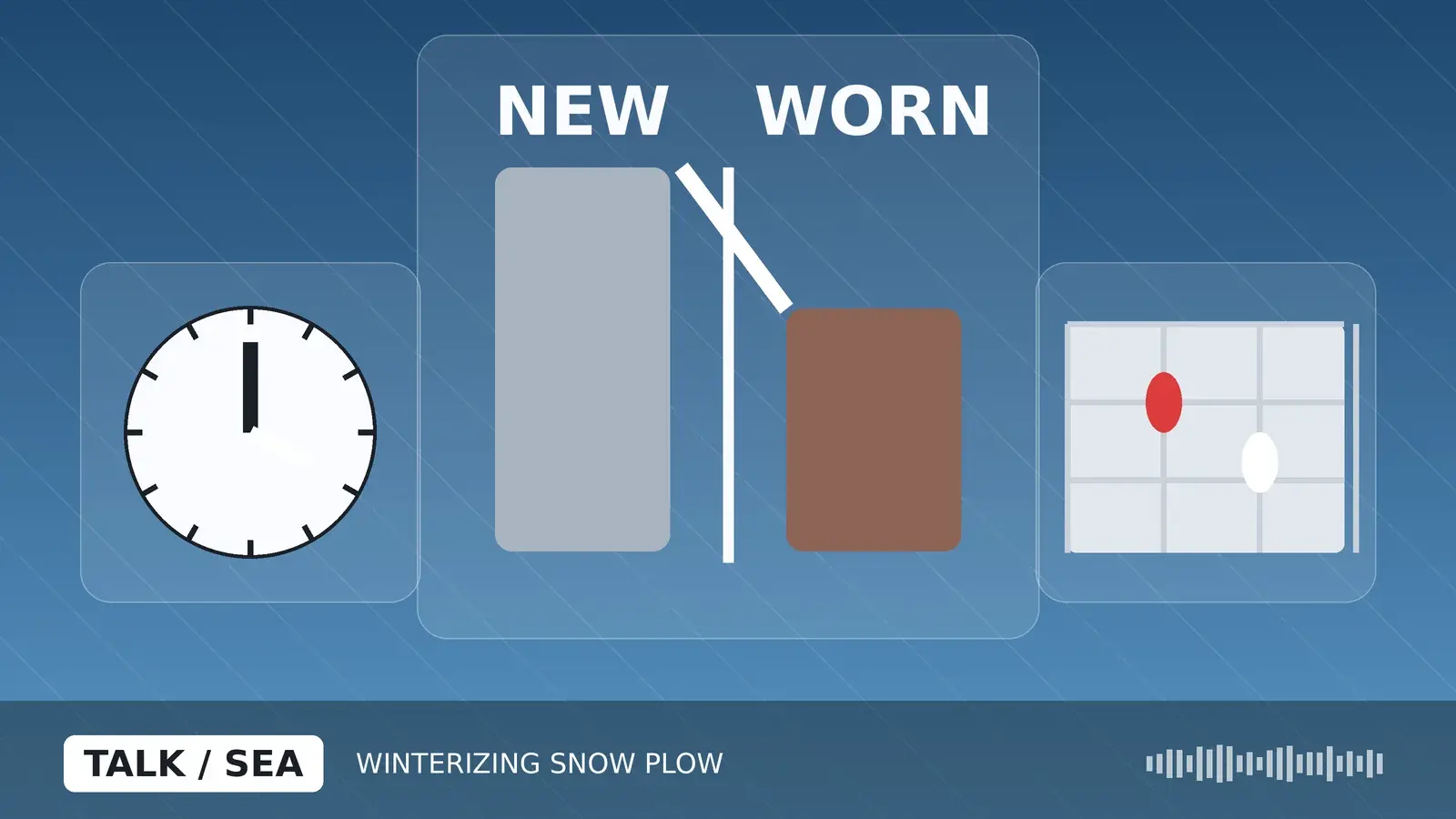
Scenario: a plow has to be inspected before the first storm and there is only an hour per truck. Direct answer: use a fixed sequence and a time budget for each part, and record findings on a sheet so repairs can be scheduled. The times are suggestions to adapt, not benchmarks. Follow your plow maker’s inspection guidance.
Maintenance checklist with time budget
0 to 10 minutes: mount and frame
- [ ] Clean the mount and the frame enough to see welds.
- [ ] Check pins, clips and mounting points for wear or cracks.
- [ ] Look at welds with a torch.
10 to 25 minutes: hydraulics
- [ ] Check fluid level and condition.
- [ ] Inspect hoses and fittings for wear, leaks and rubbing.
- [ ] Cycle lift and angle slowly; listen and watch.
25 to 40 minutes: edge and moldboard
- [ ] Measure remaining edge and decide on replacement.
- [ ] Check bolts, nuts and marks; replace damaged hardware.
- [ ] Look at the moldboard for dents, cracks and rust.
40 to 50 minutes: shoes and trip parts
- [ ] Check shoes or gauge wheels for wear and security.
- [ ] Check springs, trip mechanism or cutting-edge guards if fitted.
50 to 60 minutes: lights, controls and record
- [ ] Test lights and markers.
- [ ] Check controller and cables.
- [ ] Write up defects with priority and an owner.
Priorities for defects
The priorities decide what stops a truck and what becomes a work order.
- Stop: cracks, leaks that cannot wait, missing pins. Do not use the plow.
- Fix before first storm: worn edge, loose hardware, weak lights.
- Fix this season: cosmetic damage and minor wear.
Why a time budget helps
Without a budget, inspections drift toward the parts the technician enjoys. A time budget keeps the inspection balanced and tells you which truck needs more attention. If a truck repeatedly needs more than the hour, that is a finding in itself.
What to record on the sheet
For each truck, record the date, the inspector, the edge remaining and the decision, any hardware replaced, any fluid added, defects by priority and the repair owner. Attach photographs for anything unusual. Keep the sheet with the truck’s file so that next year’s inspection starts with this year’s notes, and so that a pattern of repeat defects is visible.
Boundary: The times are suggestions, not benchmarks, and no inspection requirement or maker specification is cited.
Further reading on this site.
Plow Shoes and Skid Shoes: Selecting by Surface and Reducing Edge Wear ↗The edge has uneven wear but the truck reports normal plowing hours. What data are missing? ↗Carbide snow plow blades ↗Overnight vs Daytime Plowing: Noise Rules, Visibility and Edge Choices ↗When to Retire a Plow Frame and Not Just the Edge: Four Tests ↗Multi-Depot Readiness Audit: A One-Page Scorecard for Edges and Hardware ↗


