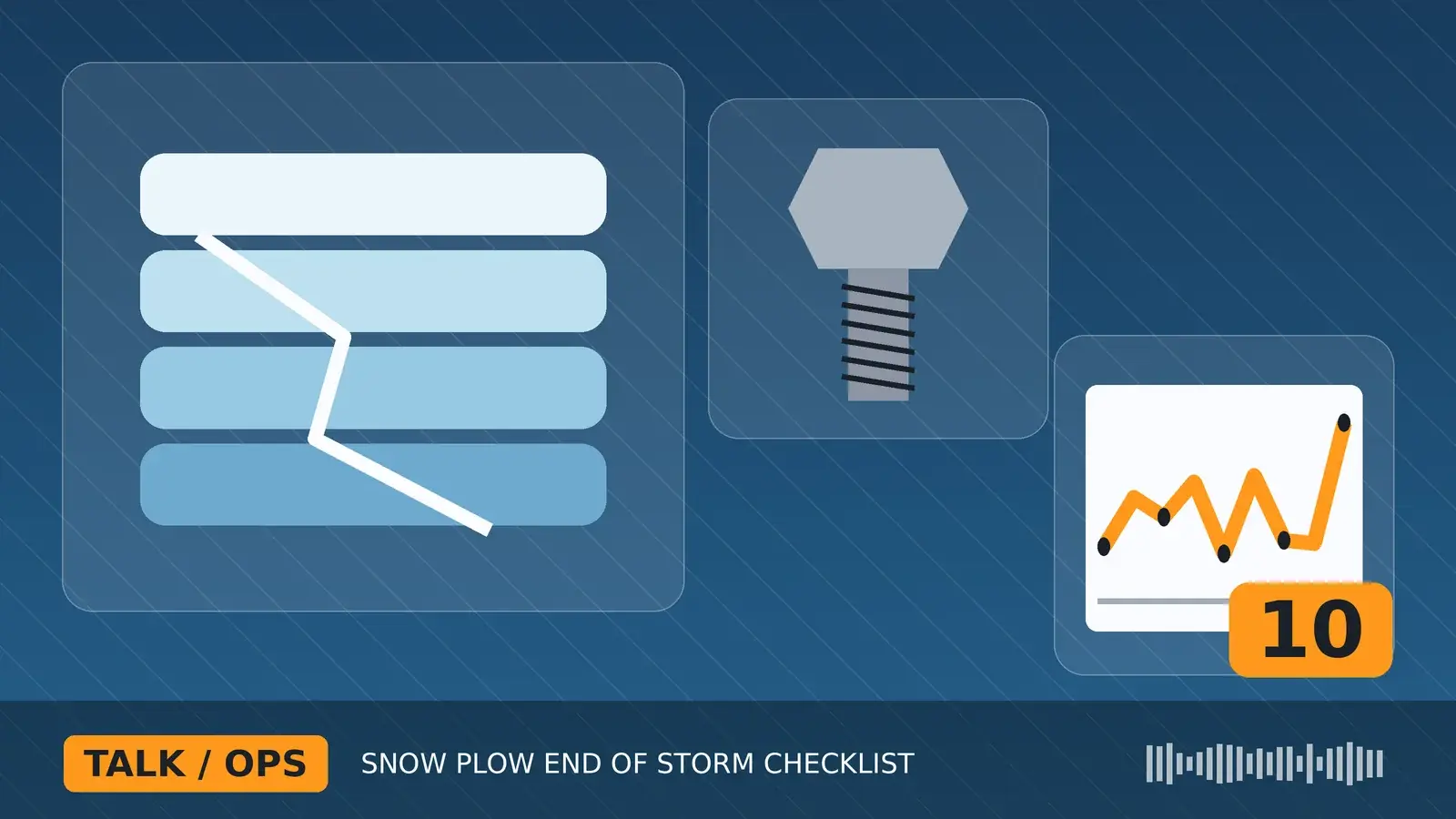
Scenario: the storm is over, the driver is tired and the truck will sit until the next call. Direct answer: spend ten minutes on a fixed walk-round before parking, because problems found now are fixed in daylight, and problems found at the next call are fixed in the dark. This is a routine to adapt, with no standard behind it. Times are targets, not measurements.
The ten-minute order
Ten minutes, six blocks, in this order. The order matters because the record comes last.
- Minute 0–1, park and secure: blade on the ground or on stands as your depot rule says, engine off, key out.
- Minute 1–3, edge: look along the full length for chips, cracks, missing inserts and uneven wear. Check the wear against your limit mark. Photograph the edge with a ruler or gauge in frame.
- Minute 3–5, bolts and mounting: look for missing, loose or stretched bolts, elongated holes and gaps between the edge and the moldboard. Tap suspect bolts and look for rust trails or shining marks that suggest movement.
- Minute 5–7, shoes and trip parts: check shoe height and wear, springs or trip mechanisms and pins.
- Minute 7–9, hydraulics and lights: look for wet hoses, weeping fittings and cracked lenses. Check lift and angle once.
- Minute 9–10, record and tag: write the result on the card. If anything fails, tag the truck and tell the shop before you leave.
What to write down
| Item | Record |
|---|---|
| Edge wear | Reading or photo name; hours since the edge was fitted |
| Damage | Location along the edge, such as “left third, chip” |
| Hardware | Number of loose or missing fasteners |
| Action | OK, watch, repair before next call, out of service |
When to tag a truck out
The tag is a decision rule, and it should be written before the shift rather than argued during it.
- Any missing or cracked insert across a wide section, or a cracked edge.
- Edge hardware missing so that the edge could move.
- A hydraulic leak that is more than a damp fitting.
Limits
If the check regularly takes much longer, your trucks may need a wash first or the card may be too long. Shorten the list rather than skip it.
Boundary: This is a routine to adapt, not a standard; the time targets are not measurements and tag-out limits must follow your own safety rules.
Further reading on this site.
Snow Plow Compatibility by Truck Model: What to Check Before Buying a Blade ↗The Snow Plow Edge Specification Checklist ↗Carbide snow plow blades ↗Plowing Intersections and Turn Lanes: Pass Order, Windrows and Edge Strike Zones ↗Sharp vs Worn Edge: Five Myths About Scraping Performance ↗Float Mode and Down-Pressure: What Clear Roads Operators Reported ↗


