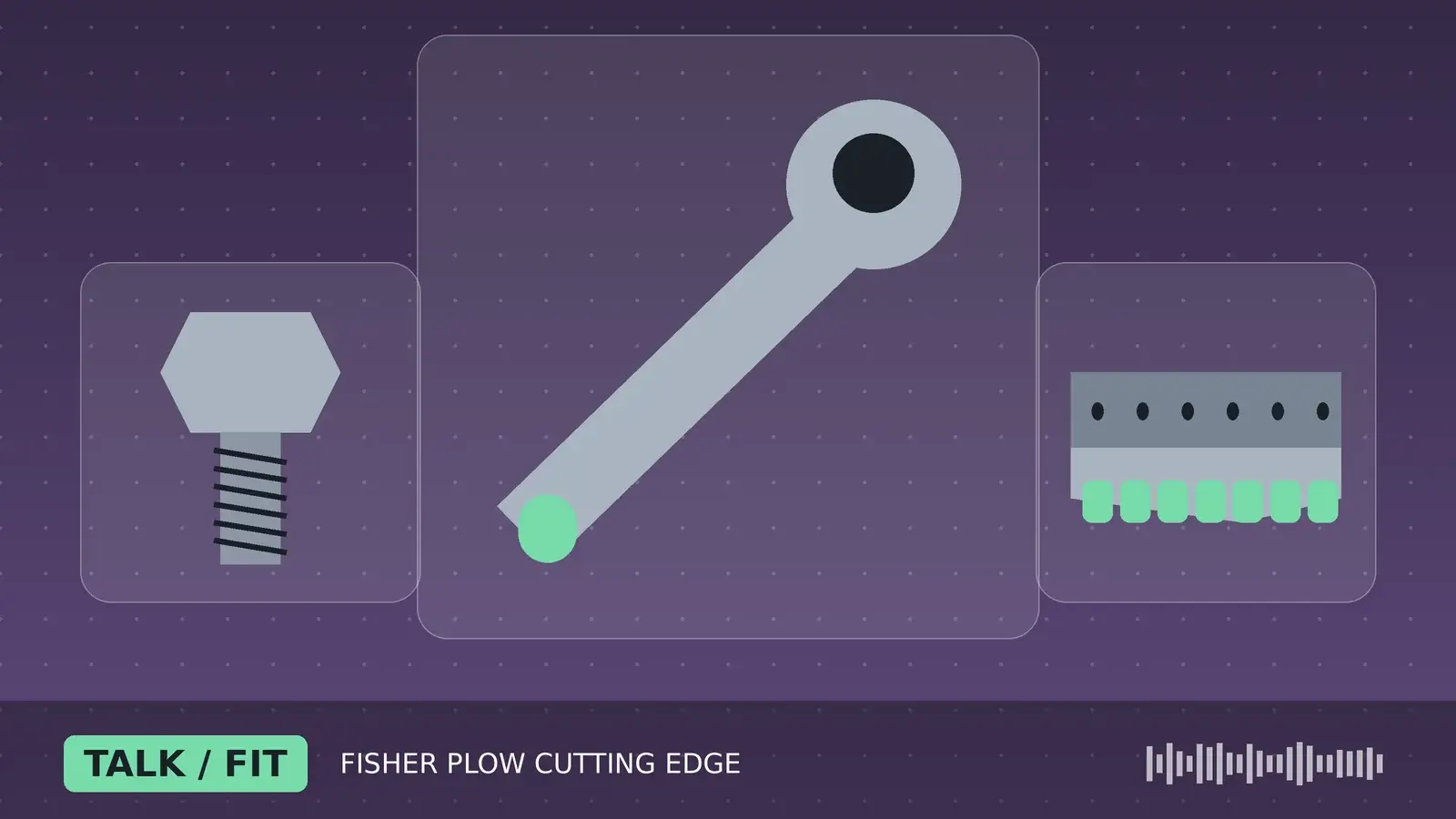
Scenario: a contractor wants to move a Fisher-style plow from steel to carbide to cut edge changes. Direct answer: verify fit and handling before ordering. “Fisher-style” is a shorthand used in the trade for a family of edges that fit that maker’s plows, so confirm the exact model and edge dimensions with your supplier. I make no claim about any brand’s parts.
| Check | Why it matters | How to confirm |
|---|---|---|
| Plow model and moldboard height | Edge profile must match the mount | Model plate, manual, photo of the old edge |
| Edge length and thickness | Affects fit and how the plow sits | Tape measure on the old edge |
| Hole pattern and hole shape | A mismatch stops the install | Count holes, measure spacing, note round or slotted |
| Hardware | Carbide edges often need specific bolts and nuts | Ask the supplier what is included |
| Weight | Heavier edges change lift and float behaviour | Ask for the unit weight, compare with the old edge |
| Shoes and ride height | Edge height changes the contact | Plan to re-set the shoes |
| Surface | Hard contact may not suit delicate pavement | Consider a trial on one truck |
Before you buy
Three steps before the order prevent most fit returns.
- Take photos of the old edge on the plow with a tape in view.
- Send photos and measurements to the supplier and ask them to confirm in writing that the edge fits your model.
- Ask for the unit weight and hardware list.
- Ask the return rule if it does not fit.
After you fit it
The first week after fitting is where a fit problem announces itself.
- Re-set the shoes and check that the plow floats and trips normally.
- Re-torque bolts after the first shift and record the date.
- Log wear and any chipping so you can compare with the steel edge.
Costs to put on paper
Write down the old edge’s cost per set, the number of changes last season, and the time each change took. Then write the quoted price of the carbide option and the weight difference. Compare totals over a season using your own numbers and a clearly labelled assumption about life. If the quote gives no life figure, ask for one and ask what it is based on; if no basis exists, treat the life as unknown and let the trial decide.
When to wait
If your work is mostly delicate pavers or painted markings, or if the plow is lightly built, discuss the options before switching. Our guides to choosing edges by surface cover the trade-offs.
Boundary: no Fisher part dimensions or compatibility claims are made. Confirm all fit details with the supplier and your plow manual before ordering.
Further reading on this site.
Snow Plow Blade Bolt Pattern: How to Verify It Before You Order ↗The part number was superseded. What should we verify before ordering the new edge? ↗Carbide snow plow blades ↗Pusher Width, Edge and Machine Size: A Sizing Table for Compact Loaders ↗Replacing a Western-Style Plow Edge: Steel, Poly or Carbide on the Same Mount? ↗


