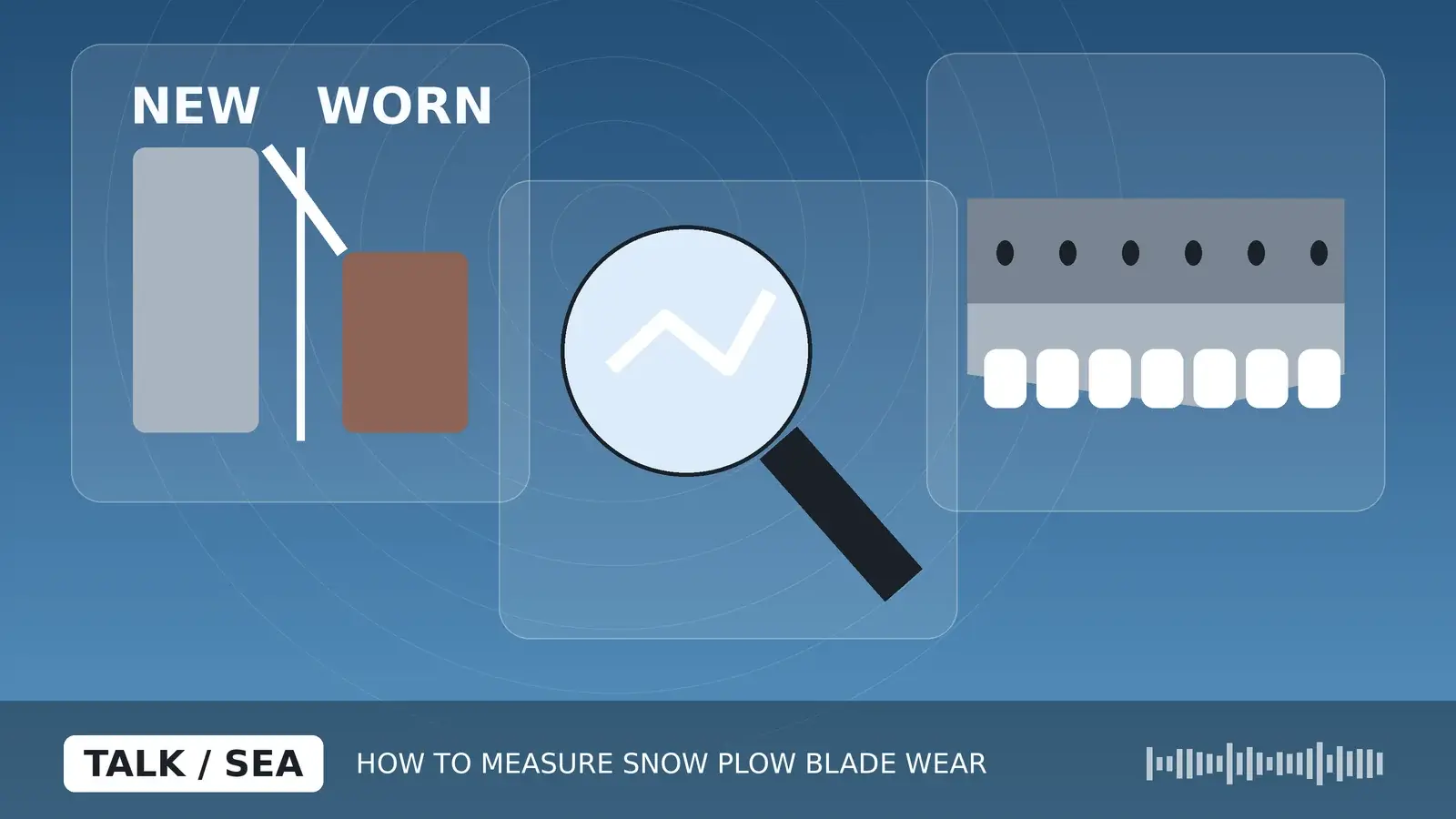
Scenario: a fleet wants to see how fast its edges wear, but the photos taken by different drivers cannot be compared. Direct answer: fix the angle, distance, scale, light and file name, and photograph the same spot every time. A consistent photo with a gauge in frame is a decent record of wear, and it costs nothing. It is a record, not a measurement: where accuracy matters, measure with a gauge too. This is a method, not a standard.
The protocol
The protocol is a fixed sequence. Change any part of it and the photos stop being comparable.
- Prepare the edge: brush off snow and grit so that the profile is visible.
- Place a scale: put a ruler or a printed card with a known length against the edge, in the same position each time.
- Fix the angle: photograph from the side, with the phone square to the edge, at the same distance. A mark on the ground or a simple jig helps.
- Mark the spots: photograph at the same positions, for example the left end, the centre and the right end, using paint marks as guides.
- Use even light: avoid strong shadows and flash glare; shade the edge if needed.
- Add a label: include a card with the edge ID and date in the frame.
- Name the file: use a fixed pattern, such as truck-edge-position-date.
Template: photo log
| Edge ID | Truck | Position | Date | Hours | Gauge reading | File name |
|---|---|---|---|---|---|---|
| Left / centre / right |
How to compare
Photos only compare if they are taken the same way. Three rules make the log usable.
- Open two photos from the same position side by side and compare the remaining height against the scale. A photo without a scale cannot be measured later.
- Record the reading in the log, so the comparison does not depend on remembering the photos. Memory is not a record.
- Use hours of use between photos, not calendar dates. A blade that worked four storms and one that worked one are not comparable by date.
Common mistakes
The photo log fails for reasons that have nothing to do with photography.
- Different distances, which change apparent size.
- Snow or dirt on the edge hiding the wear line.
- Missing labels, so photos cannot be matched to edges.
- Storing photos on personal phones without a shared folder.
Limits
Lens distortion and angle introduce error. Use the photos for comparison and keep a gauge reading for any decision that matters.
Boundary: Photos are a comparison record, not a calibrated measurement; lens distortion and angle add error, so keep a gauge reading for any decision that matters.
Further reading on this site.
Plow Blade Wear Measurement: When to Rotate and When to Replace ↗Can a phone video of blade chatter establish the cause? ↗Carbide snow plow blades ↗Holiday Storms and Parts Availability: What to Stock Before Shipping Cutoffs ↗Contractor Preseason Checklist: Edges, Shoes, Hardware and Sub-Sign-Ups ↗Sand and Cinders in the Snowpack: Does Abrasive Material Speed Edge Wear? ↗


