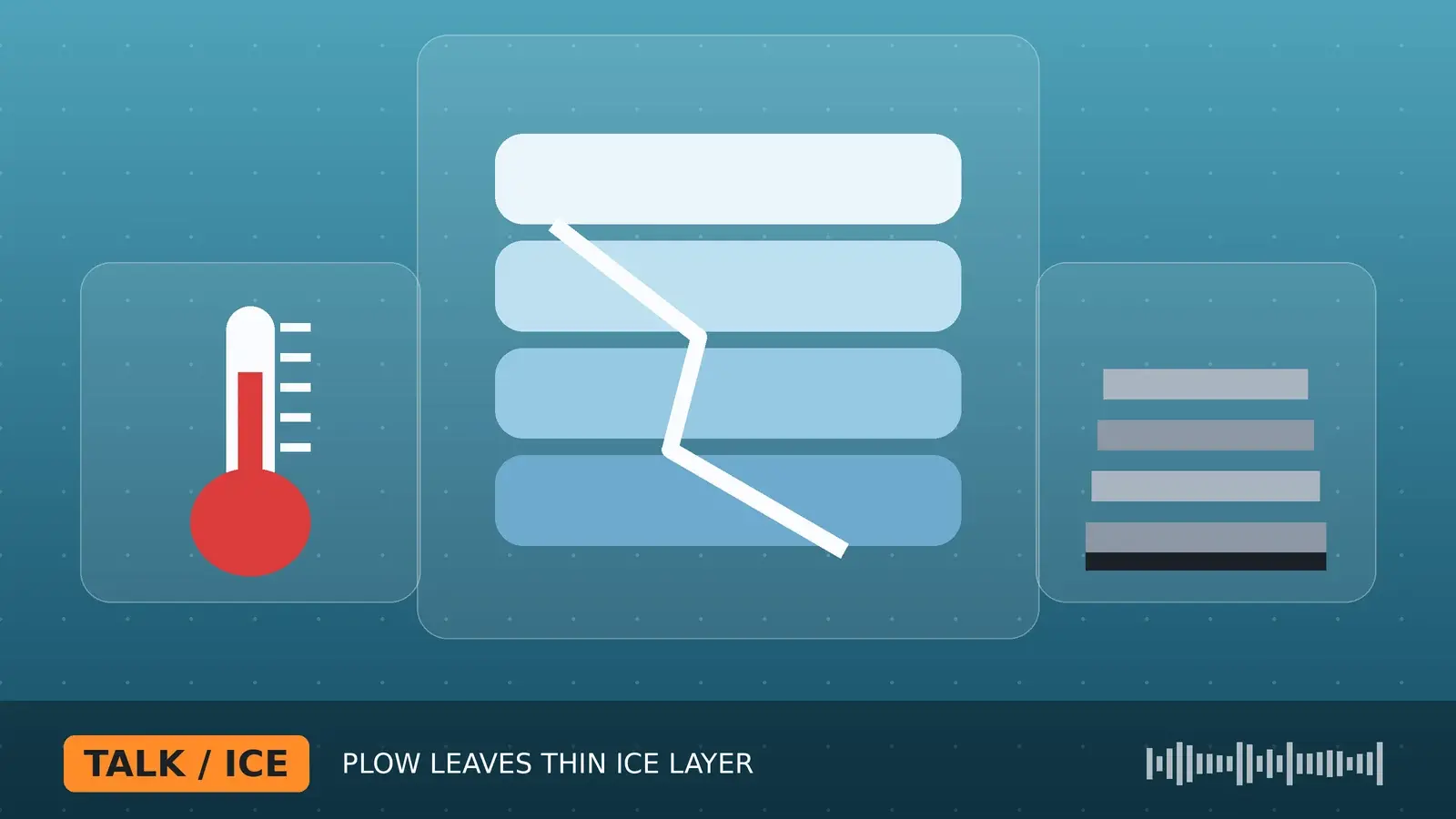
Scenario: the plow passes, the road looks cleared, and a few minutes later a glossy film shows in the wheel path. Direct answer: work through four suspects in order: edge condition, plow set-up and speed, timing against the storm, and treatment. The film is a symptom with several possible causes, so test one change at a time. This is a field guide with no measurements or temperature rules.
Troubleshooting table
| Suspect | What to look for | Quick test | Possible fix |
|---|---|---|---|
| Edge condition | Worn, rounded or chipped edge; uneven wear along its length | Look at the edge and the scrape line on the road | Replace or rotate the edge; check for bent sections |
| Set-up and speed | Too light a down-pressure, too high a speed, edge riding up on the snow | Watch the scrape line at different speeds on a quiet stretch | Adjust pressure, angle and speed |
| Timing | Passes too late, after snow was packed by traffic; or too early, with snow still falling | Compare film with the time of each pass in the log | Change pass timing or frequency |
| Treatment | No treatment after the pass where the surface is cold, or treatment applied too late | Check what was applied and when | Adjust treatment plan with your supervisor |
| Surface | Rough or uneven pavement that holds a thin layer | Look at pavement texture and joints | Note the location and consider a different approach there |
Steps
A film left behind is usually a timing or edge problem, and the order of checks matters.
- Record where and when the film appears, and the condition of the surface.
- Check the edge and the scrape line first; they are the quickest to rule out.
- Change one factor, such as speed, and see the effect on the next pass.
- Talk to the supervisor about timing and treatment.
- Write down what you changed and what happened.
Limits
A thin film can also come from refreezing of meltwater or from conditions outside the plow’s control. If the film persists after the edge and set-up are right, treatment and timing are more likely causes than the blade.
One change at a time
If you alter edge, speed and treatment together, you will not know which helped. Keep a short note of each change with the time, so that you can link results to actions.
Boundary: No temperatures, treatment rates or pressures are given; the causes listed are possibilities to test, not diagnoses.
Further reading on this site.
Packed Ice Prevention on Municipal Routes: Cutting Early Before the Layer Sets ↗A blade scrapes well at first and leaves more snow later in the shift. What should the log capture? ↗Packed ice carbide kit ↗Low-Visibility Plowing: Why Setup Matters for Edges ↗Packed Ice, Black Ice and Frost Layers: A Field Identification Guide for Crews ↗Smart-Salting Certification and the Plow Pass: What MPCA Says ↗


