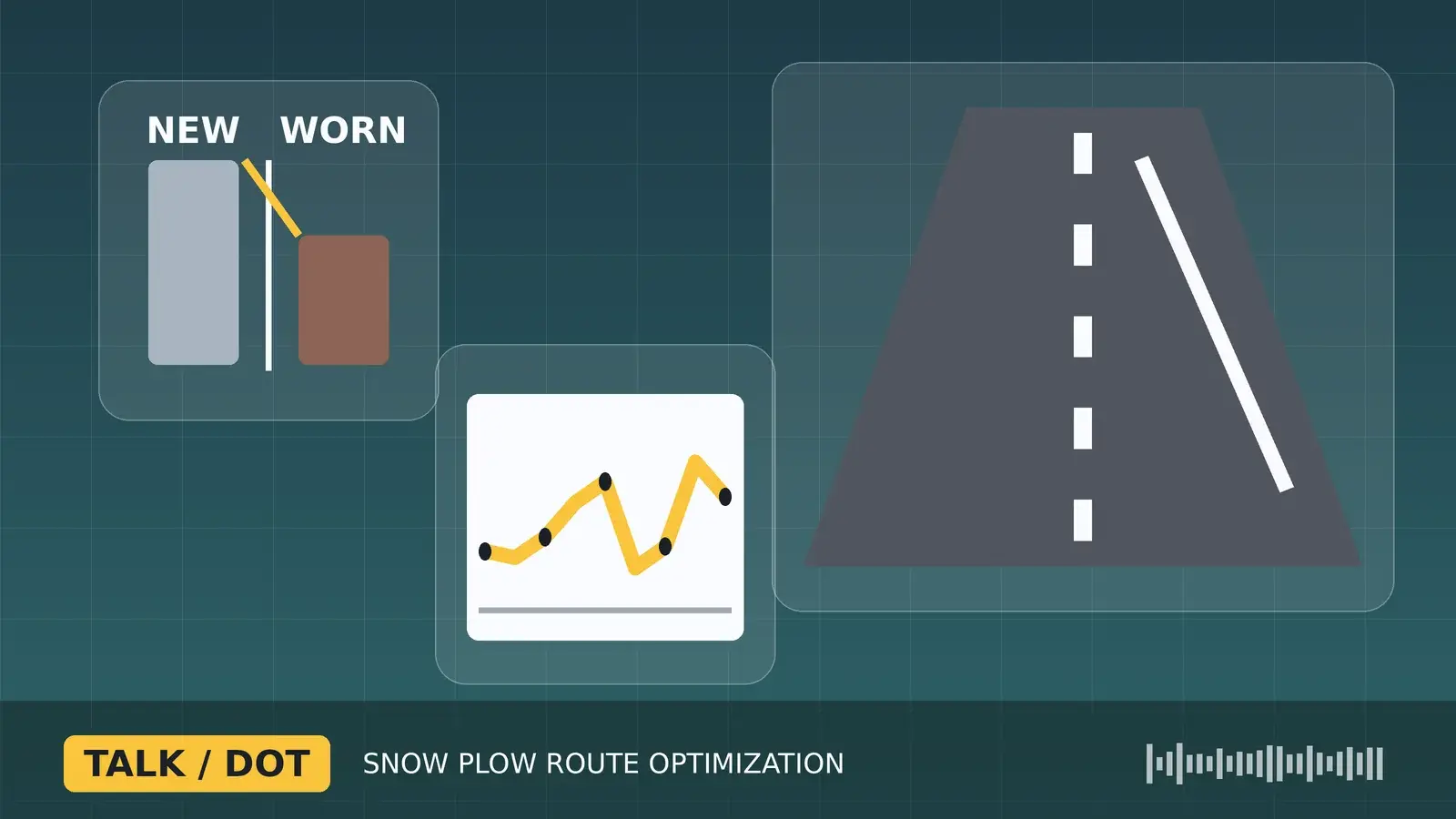
Question: if your agency adopts smarter routing, will edges wear faster or slower? Honest answer: the public research does not say. The FHWA report (FHWA-HOP-24-043, July 2024) assesses technical, market, financial and institutional readiness for adaptive route optimization (ARO). It does not report blade-wear results. Anything about wear below is reasoning for you to test, not a finding.
What the report does say
The report defines the concept before it evaluates it.
- ARO is defined as dynamically routing winter maintenance vehicles across a network in response to real-time weather, traffic, incidents, work zones and resource constraints.
- It cites state DOT spending of more than $2 billion a year on snow and ice control and more than $5 billion a year on repairs due to snow and ice operations, chemical use and wear, so even small routing gains could matter.
- Its benefits are framed as potential: less deadheading, shorter cycle times, less fuel. It recommends prototype and pilot demonstrations that compare routes and cycle times with traditional plans.
Decision steps for your own edge records
Route changes move wear around the fleet, usually without anyone noticing. Check these five before the change goes live.
- Does it change blade-down distance? A shorter route with the same load can still wear less, or more, depending on passes.
- Does it change the surface mix? Moving a truck from smooth urban pavement to chip seal changes edge life more than distance does.
- Does it change how often a route is repeated in one storm? More light passes can wear more than fewer heavy ones.
- Does it change which trucks cover which routes? A few trucks absorbing the longest legs will show up as fleet-wide edge failure.
- Is a pilot planned? Ask for edge height readings at the start and end, on both the old and the new routes.
If you cannot measure, do this
Keep a small spares cushion for the first season after any route change, and check edge height on the busiest truck every week rather than every month. Then adjust. This is practical advice, not a research result.
Boundary: the report is a readiness study that recommends prototype and pilot steps before any national rollout. Do not quote it as proof that routing saves edge cost.
Sources and further reading. External references are dated; where a figure is quoted, the link shows where it came from.
Federal Highway Administration: Adaptive Route Optimization for Operations: Feasibility and Readiness Report (FHWA-HOP-24-043) (July 2024) ↗Carbide vs Steel Blades: The Cost-per-Lane-Kilometre Calculation ↗Snow Plow Production Rates and Fleet Capacity Planning ↗Carbide snow plow blades ↗


