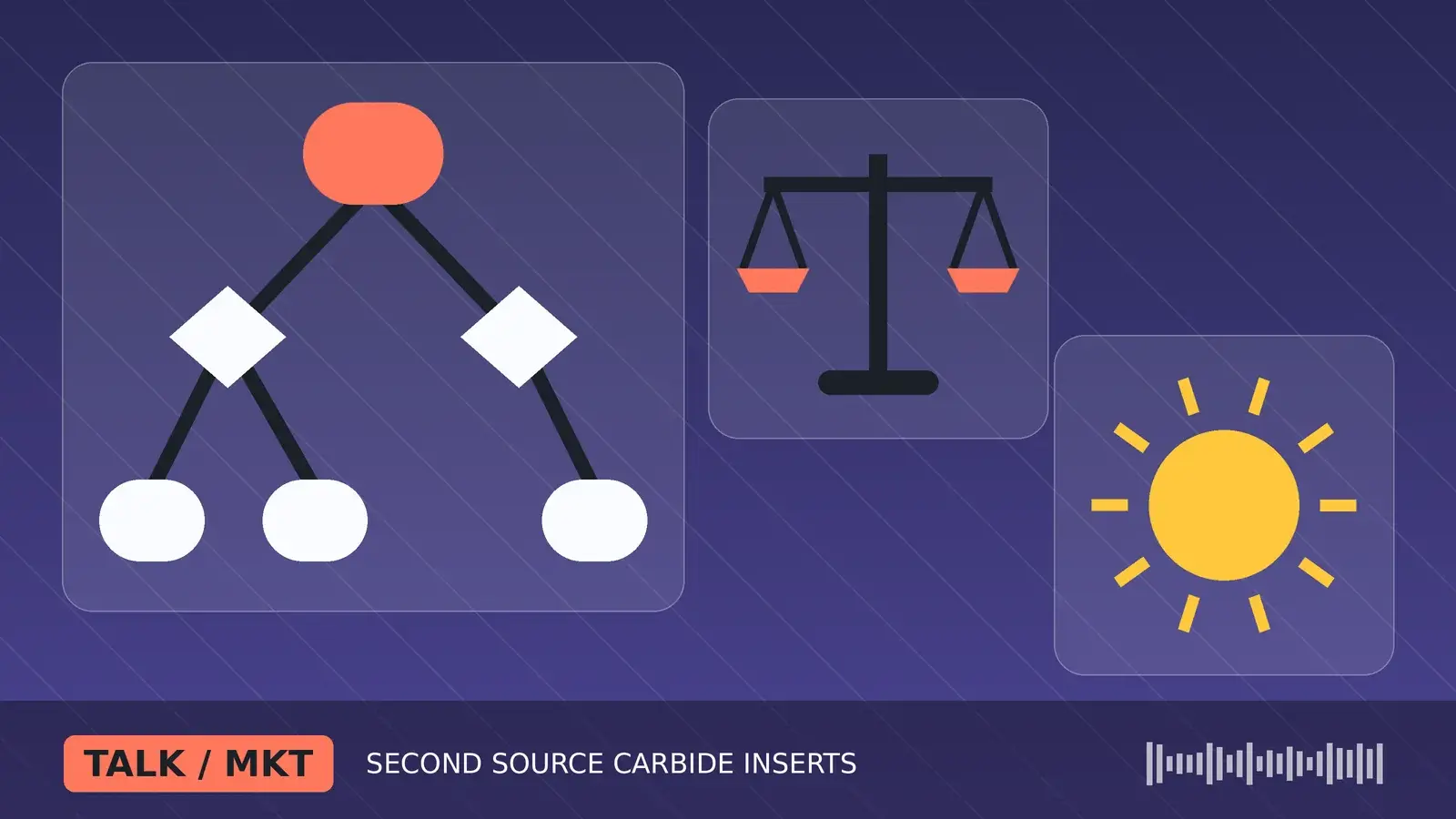
Scenario: all your inserts come from one supplier and you wonder whether a second source is worth the effort. Direct answer: it depends on how much a stoppage would cost, how hard it is to switch and how much volume you have. Work down the tree. I do not claim any market shortage; the reasoning is general supply-chain practice.
The tree
The tree starts from consequence, and most branches end in keeping the current supplier.
- Would a four-week supply gap stop routes or contracts?
- No → a second source is optional; keep a larger stock instead and review yearly.
- Yes → go to 2.
- Is the insert a standard design that several suppliers can make to your drawing?
- Yes → qualification is likely feasible; go to 3.
- No (proprietary or odd shape) → a second source may mean a tooling cost; go to 4.
- Is your annual volume large enough to split without losing price or attention from your current supplier?
- Yes → qualify a second supplier with a small share.
- No → qualify a second supplier as a standby, with a small trial order each year.
- Can you tolerate holding more stock instead?
- Yes → build safety stock and re-check each season.
- No → ask the current supplier about a second production site or a protected stock.
What qualification involves
Qualification is a sequence, and the drawing is the part that has to come first.
- Share the same drawing and inspection requirements with both suppliers.
- Order samples and inspect them against the drawing, including dimensions and visible defects.
- Fit them to a few edges and log wear and breakage beside the current product.
- Decide the acceptance rule and record it.
- Place a small recurring order so the second supplier stays warm.
Costs and risks
A second source is an insurance policy, and the premium is the qualification work.
- Time for sample checks and trials.
- Possible small differences between suppliers that affect fit or brazing.
- Splitting volume may reduce your price from the first supplier.
What to record
Keep a one-page file for each supplier: contact, products approved, last trial date, results, and the date you will next test them. That file is what turns a “second source” from a name into a usable option.
Boundary: general reasoning only; no claim is made about any supplier or market condition. Verify fit and quality on your own samples.
Further reading on this site.
How to Source Carbide Snow Plow Blades From an Overseas Manufacturer ↗Do we need separate evidence for the steel body and the carbide inserts? ↗Tungsten carbide inserts for snow plow edges ↗What Is an MTU? Reading APT Price Quotes Without Getting Lost ↗Tungsten as a Conflict Mineral: What Customer Reporting Requests Look Like ↗When Stock Is Allocated: How Distributors Secure Preseason Edge Supply ↗


