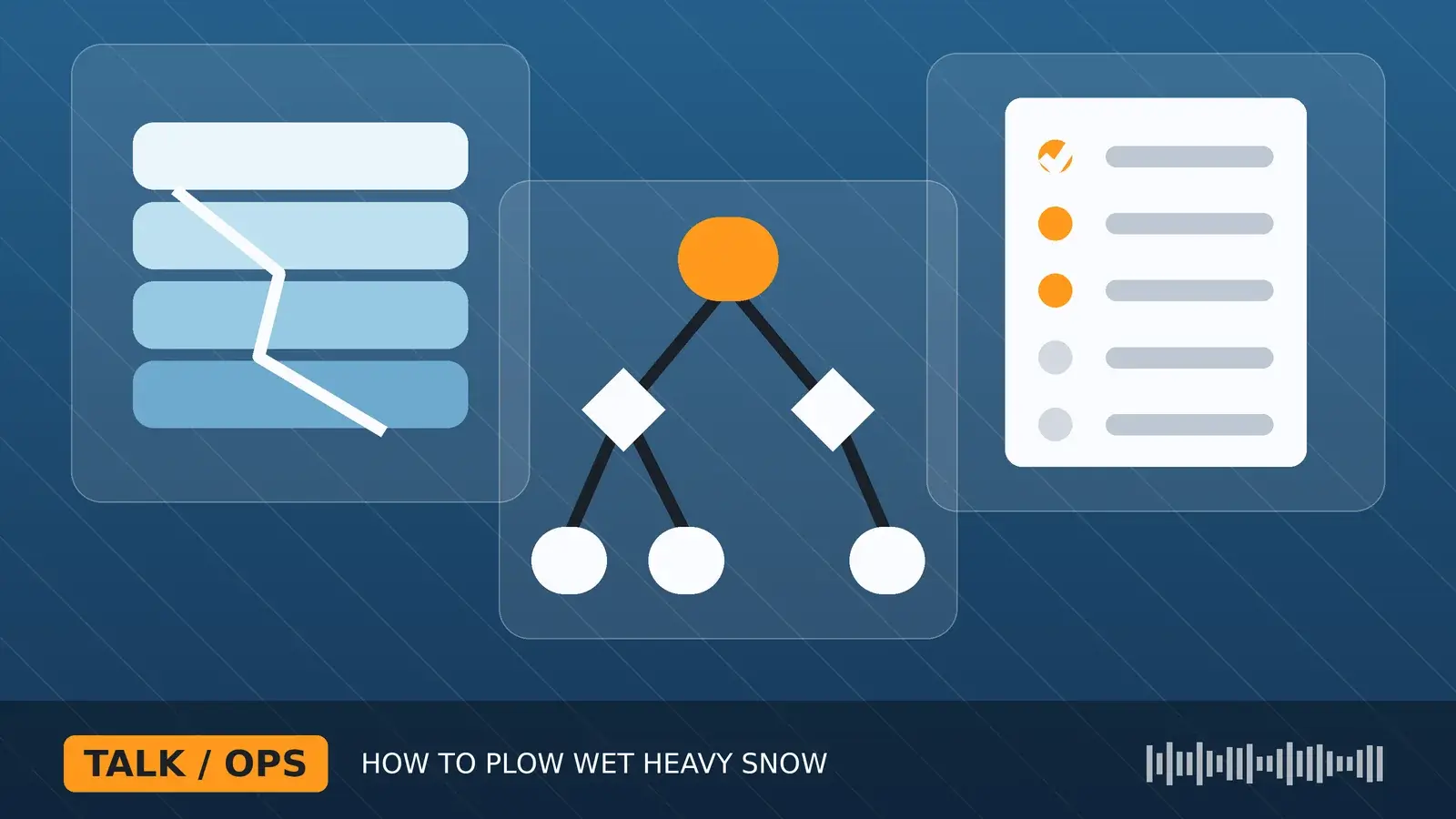
Scenario: the snow turns wet and heavy and the plow starts to labour. Direct answer: work through the tree below, adjusting pass depth, speed and angle before you change anything on the truck, and check the edge afterwards because heavy snow loads it harder. The decision tree is practical advice from field practice, not a tested procedure, and your agency’s or client’s rules come first.
What counts as wet snow
The National Weather Service briefing page I read on 24 October 2026 shades a snow-to-liquid ratio of 1 to 11 to 1 as wet snow, 11 to 20 to 1 as normal and 20 to 1 or more as dry. Another NWS page says the ratio is lower when the warm layer is deeper and closer to freezing, and that ratios can change dramatically within a single event. So “wet” can arrive mid-storm, and you may need to change your approach during a shift.
Decision tree
| If you see | Then try | Check afterwards |
|---|---|---|
| The plow labours or the truck loses speed | Take shallower passes; return more often | Fuel use, hydraulic temperature |
| Snow rolls but windrows are heavy and tall | Reduce speed so it does not throw onto parked cars or driveways | Spill-back into cleared lanes |
| Snow packs on the moldboard | Clear the plate at stops; keep moving to let snow roll | Plate condition |
| Edge chatters or skips | Check down-pressure and angle; look for a worn or chipped edge | Edge wear and mounting |
| Heavy snow over ice | Treat the ice separately; do not overload the edge | Edge chips |
| Wet snow, rain forecast | Prioritise key routes; plan a return pass | Re-freeze risk later |
Steps for the driver
Wet snow changes the physics, and the driver is the first person who can see it.
- Note that the snow has turned wet and tell dispatch. Information travels slowly, so say it early.
- Shorten passes and reduce speed to what the plow can roll.
- Stop to inspect the edge and mounting after the first heavy run.
- Record the snow condition and any edge issue on the pre-trip card.
For the shop
Heavy snow loads the edge, the moldboard, the mount and the hydraulics more. After a wet storm, check bolts, shoes and hoses first.
Limits
The tree is a guide. It does not replace your agency’s procedures, and it makes no claim about edge life in wet snow.
Boundary: The tree is practical advice, not a tested procedure, and it does not replace your agency’s rules; no claim is made about edge life in wet snow.
Sources and further reading. External references are dated; where a figure is quoted, the link shows where it came from.
National Weather Service (Gaylord, MI): Briefings – Winter Weather (snow to liquid ratio legend) (undated page; read 2026-10-24) ↗National Weather Service (La Crosse, WI): What Are Snow Ratios? (undated page; read 2026-10-24) ↗Down-Pressure, Blade Angle and Speed on Hardpack Surfaces ↗Why might an edge that clears packed snow leave a wet film in slush? ↗Carbide snow plow blades ↗Sharp vs Worn Edge: Five Myths About Scraping Performance ↗Float Mode and Down-Pressure: What Clear Roads Operators Reported ↗After the Storm: A 10-Minute Edge and Hardware Check Before You Park ↗


