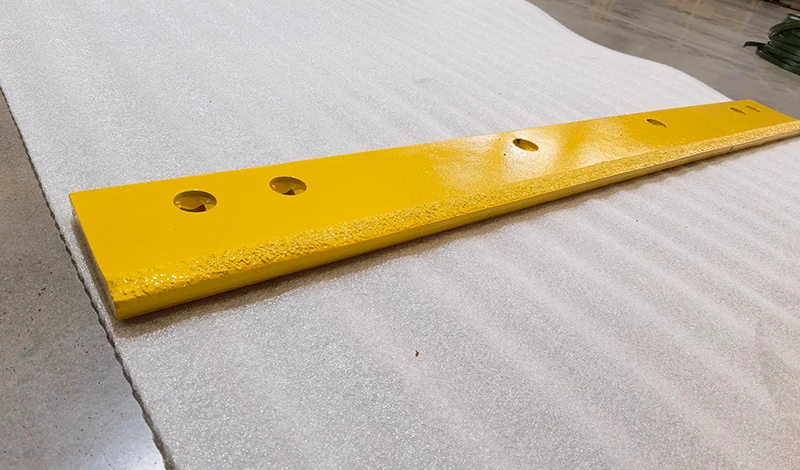
No. Matching bolt spacing is a useful starting check, but it does not establish that a replacement blade will fit. It confirms only part of the mounting pattern. You still need to reconcile the complete blade specification with the actual machine, its mounting arrangement and the equipment manufacturer’s requirements before approving an order or installation.
Compare the complete blade and mounting pattern
The first distinction is between a repeating pitch and a complete hole pattern. Use the blade selection guide to frame the wider fit and application review. Two blades can have the same distance between adjacent holes while differing in the position of the first hole, the distance to an end, or the height of the row above the working edge. Compare positions from stated reference edges. Also check hole diameter and shape, any countersink or recess, and the blade’s overall length, height and thickness. Those details should be visible on the comparison drawing rather than left implicit in the phrase ‘same bolt pattern’.
Next, look beyond the blade itself. When reviewing a carbide replacement blade, check the assembly as well as the blade drawing. A direct-bolted edge and a clamped assembly can have different seating requirements. Wear plates, carriers and other parts in the mounting stack may affect fastener suitability and clearance. The edge profile and working position also matter: a blade that accepts the bolts may still sit incorrectly. The linked Henke manuals illustrate why hardware and edge-height requirements can be specific to a machine or edge type. Their values should not be transferred to an unrelated plow.
Separate measured dimensions from assumptions
Without an original drawing, a worn sample can still be useful evidence. Keep the machine and attachment identification, existing part reference and photographs together. Separate dimensions measured from the sample from dimensions confirmed by an original specification. Mark wear, deformation and missing features as uncertainties. In particular, the remaining height or shape of a worn working edge is not automatically its original design geometry. Ask the supplier which additional measurements, photographs or physical sample checks are needed to propose a drawing.
A useful comparison therefore records both a value and its source. For example, state whether a dimension came from the existing part, a machine document or a supplier proposal. If two references disagree, keep both visible and ask which controls the replacement. This is especially important when the part number is incomplete or a previous replacement may already differ from the original. A tidy drawing is not enough if its assumptions remain hidden.
Confirm the specification before ordering
For the purchasing handoff, I would want the following points recorded before release:
- The machine and attachment configuration, including the relevant mounting arrangement.
- The proposed blade drawing and revision, with reference edges and dimensions clearly identified.
- Any unresolved dimensions, proposed deviations or features reconstructed from the worn sample.
- The equipment requirements for hardware, seating, working position and clearance.
- Who will review the machine-side interface and who can approve the final specification.
That creates a reviewable specification instead of an assumption of interchangeability. A quotation can identify the proposed solution, but it should not silently turn unknown measurements into approved dimensions. Keep the unresolved points visible until the responsible reviewer has checked them.
Finally, have a qualified technician follow the equipment manufacturer’s isolation and fitting procedures. Do not enlarge holes, force the blade into position or substitute hardware to overcome an unresolved mismatch. Even a confirmed dimensional fit does not establish carbide grade, wear life or suitability for every surface. Those are separate application checks. The practical answer is therefore: use matching bolt spacing to begin the comparison, and use an approved complete specification to finish it.
Sources and further reading. Equipment examples are model-specific; they do not establish compatibility with another machine.
Snow plow blade selection guide ↗Carbide snow plow blades ↗Henke loader snowplow manual: model-specific cutting-edge hardware ↗Henke multiblade manual: model-specific edge-height requirements ↗


