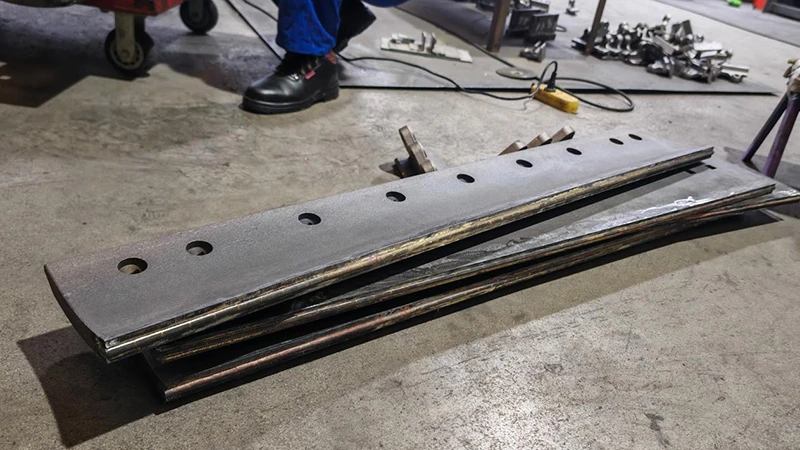
Record the observed service interval and the actual removal reason, but do not label it a wear-out life. Keep remaining condition and the incident evidence separate from ordinary wear progression. The event belongs in the trial's operational history and cost record; whether it supports a durability or product-cause conclusion requires the relevant assessment and the trial's stated rules.
Keep the removal reason separate from remaining wear condition
Identify the blade, equipment and event, including the service accumulated before removal. Preserve the condition observations made by qualified personnel and the reason the item was taken out of service. Distinguish a confirmed finding from an initial report or suspected cause. If the blade could not be examined fully, state that limitation. An urgent removal decision should not be rewritten later as a measured wear threshold simply because the analysis needs an endpoint.
The failure-mode discussion provides broader investigation context, but this trial question is about correct classification of the observed endpoint. Keep the incident report and technical assessment connected to the trial record without copying unsupported causal language into the performance summary. Record whether the item remains available for examination and what authorized handling has occurred. Its remaining material may help describe condition, but it does not prove what its future service would have been.
Retain the service and incident record without assigning a false wear-out life
Use separate fields for service duration, removal category and measured or assessed condition. If the candidate was removed for incident damage and the control reached a normal replacement condition, explain that the endpoints differ. Do not infer that the candidate would have lasted a particular additional interval or exclude it entirely from the operational record because the event was inconvenient. Both shortcuts hide information relevant to the fleet's actual experience.
Apply the trial's existing treatment of unusual events, with any necessary review documented transparently. If rules were not defined in advance, describe the analytical choices and show how they affect the conclusion rather than presenting one classification as inevitable. A wear-rate analysis may use the valid observations before the event while a whole-service cost report includes the actual interruption. Those are different questions and can legitimately use the record differently when their scopes are clear.
Report durability and operational interruption transparently under the trial rules
Report actual repair, replacement or disruption resources only where documented, without assuming the supplier or blade caused every consequence. Keep any commercial claim separate from the trial classification. If the event raises a safety or equipment concern, the responsible operational and technical owners should address it under normal procedures; maintaining a comparison is not a reason to continue with unsuitable equipment or delay assessment.
For a blade incident review, provide the event record, supported identity and pre-removal observations. Ask which further evidence is needed to answer the technical question, not for a predetermined explanation that preserves the preferred trial result. Close the analysis with the observed service and removal category intact, an explicit limit on wear-life inference and a transparent account of the event's operational impact. The study can remain useful even when one blade's normal wear-out endpoint was never observed.
Further reading. Clear Roads evaluation ↗



