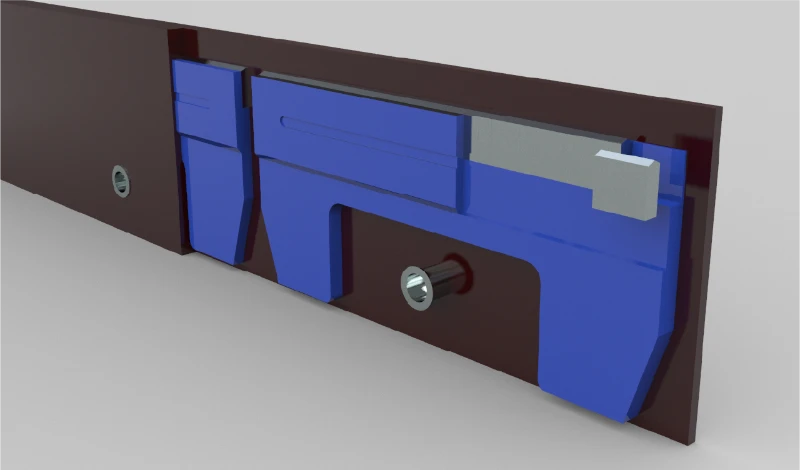
No. Segmentation describes the division into pieces; useful movement depends on the complete design and its condition. Request the documented range and direction of movement, then evaluate the actual missed areas within approved operating conditions.
Explain that segmentation and available movement are separate design features
Ask the supplier to identify what moves in the proposed assembly and how the segments are retained. A blade can be divided for replacement convenience without every piece having independent travel. Even a system designed to move has configuration-specific limits. Do not infer those limits from the number of sections or from the word articulating alone.
The articulating-edge guide covers the wider mechanism discussion. This enquiry is specifically about the claim that every depression will be reached. Describe the route features and the observed missed pattern so the supplier can respond to a real requirement instead of an unlimited conformity expectation.
Request the manufacturer's documented motion limits and maintenance conditions
Request the manufacturer’s documented movement directions, limits and conditions of use for the complete arrangement. Ask what inspection and maintenance conditions must be met for that movement to remain available. Have the equipment reviewer compare the proposed mount, carrier and segments with the actual machine. Do not assign a travel value from a photograph or a demonstration on a different assembly.
Use the relevant installation and maintenance documents to establish the equipment requirements. If the supplier’s component is an alternative, its assembly compatibility still needs a separate review. A candidate that bolts on has not automatically demonstrated the intended motion, and a freely moving unloaded segment has not by itself demonstrated the required clearing result.
Observe missed areas without assuming unlimited conformity
Record the missed areas by location and shape, with the surface condition and authorized operating context. Compare those observations with the proposed system’s documented capability. Where the depression or task lies outside the supported application, retain that limit instead of proposing extra force or an unapproved modification to make contact.
For a rubber-flex segmented blade enquiry, ask for a bounded statement of what the assembly is designed to address. An approved trial should assess the actual residual pattern and equipment condition, including any constraints that prevented a complete comparison. The decision can support a particular route application without promising contact with every surface feature. Clear limits are more useful to purchasing and operators than a broad conformity claim that cannot be inspected or verified.
Primary references support the specific points linked above; equipment documentation applies to its stated models.


