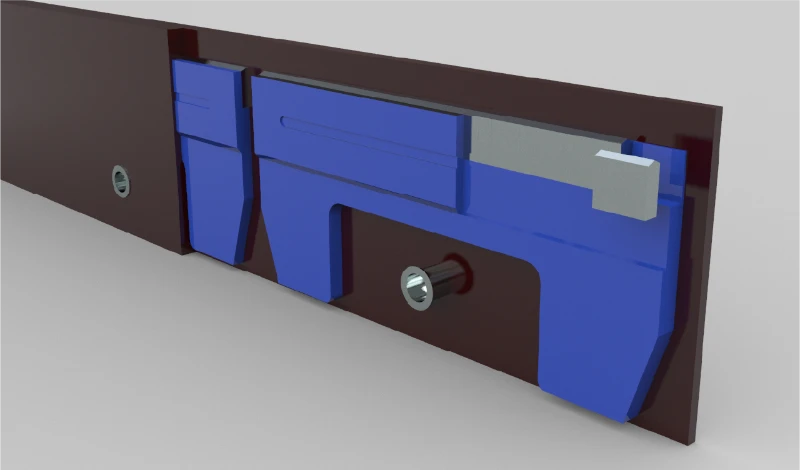
Identify the assembly and its intended movement from the correct documentation, record the visible condition and maintenance history, and request qualified assessment. Do not force a segment to reproduce a neighbour's movement. Similar appearance does not establish that every position has the same permitted motion or condition.
Describe expected motion using the correct assembly documentation
Record the machine, attachment and fitted segment references, including any earlier replacements. Photograph the complete segment arrangement and mark the affected position. Obtain the assembly documentation that applies to this configuration. A general product description of flexibility is not an inspection instruction and cannot establish how much a particular installed segment should move.
Describe the observation in plain terms: movement appears restricted, position differs from neighbouring pieces, or the operator reports a change in clearing behaviour. State how the observation was made. An observation during operation and a qualified workshop check are different kinds of evidence; neither should be rewritten as the other.
The articulating-blade background guide discusses the broader mechanism. This enquiry should stay with the particular segment and the evidence needed to establish whether its condition differs from the assembly's approved requirements.
Record visible debris, damage and maintenance history without forcing movement
Under the equipment's safe inspection procedure, photograph accessible debris, damaged material, retention features and interfaces with neighbouring pieces. Record what cannot be seen. Do not pry, hammer or apply heat to create motion for a photograph, and do not remove material that the investigator has asked to preserve. An intervention may be necessary, but it belongs under qualified maintenance instructions.
Add the last known satisfactory inspection, storage history, reported impacts and previous work at this position. If debris is visible, record it without declaring it the cause of the restriction. If the segment was already cleaned or adjusted before reporting, list the work and identify which photographs show the condition afterward.
The official documentation route helps locate applicable equipment instructions. Where the assembly is not covered by the available manual, ask the supplier or equipment authority to identify the correct document rather than applying a familiar procedure from a different design.
Seek qualified assessment of the whole retention system
Send the position map, identification and chronology to the qualified reviewer. Ask for assessment of the retention and adjoining assembly as well as the segment itself. FISHER's support guidance illustrates why hands-on identification and diagnosis may be needed; it does not establish compatibility or the cause of this particular restriction.
Keep the questions distinct: what condition was found, what action is approved, and what evidence supports the explanation? If an authorized intervention restores expected behaviour, record the before-and-after observations and other changes made at the same time. Restoration alone may not identify which feature was responsible.
For a replacement segment enquiry, include the full assembly reference and the approved disposition. Avoid ordering solely by the loose piece's appearance or assuming that a new segment can be fitted without inspecting its surrounding interfaces. The useful endpoint is a documented safe assembly and a clear record of what remains uncertain, rather than a forced movement demonstration or an unsupported material diagnosis.
Sources and further reading. The ordered specification and applicable equipment documentation control acceptance and service decisions.
WESTERN official document library ↗FISHER official support and identification guidance ↗


