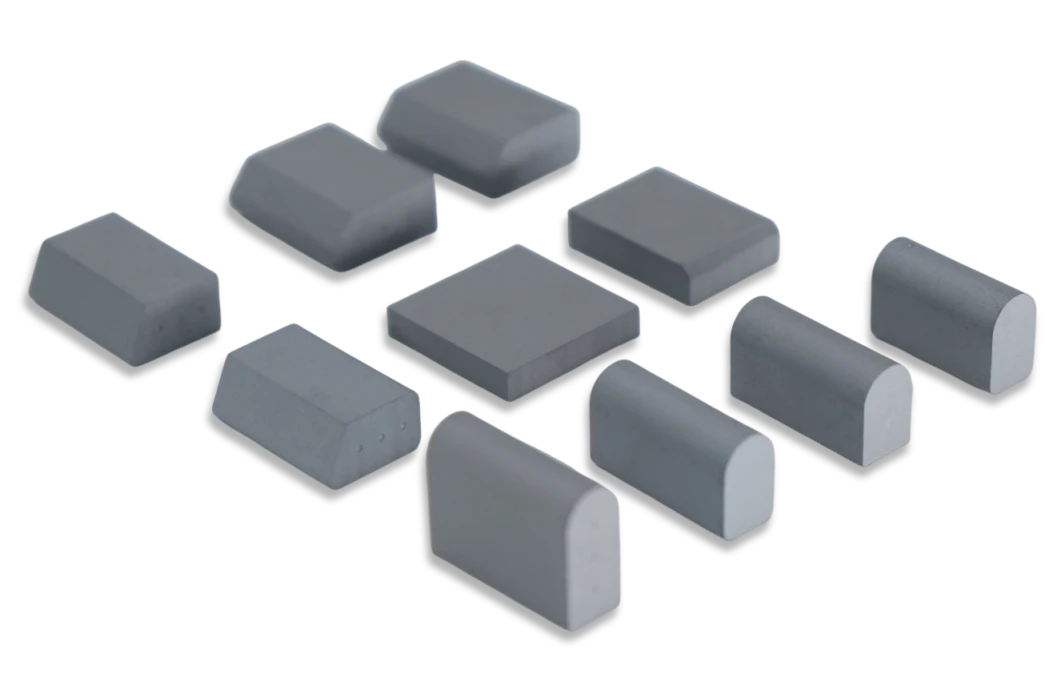
Choose the grade for the wear mechanism, the geometry for the machine, the spacing for the surface, and the replacement policy for the workshop. In that order, the edge stops surprising you.
Inserts are bought twice: once in the quotation and once every time a fleet decides whether to re-plate an edge or replace it. This guide covers the decisions that sit behind both — the sintering grade, the insert geometry, the density along the edge, the fitment tolerance that decides whether the batch bolts on at all, and the inspection routine that catches a problem while it is still cheap.
Grade first: choose for the wear mechanism, not the hardness number
Abrasion and impact want different grades. Buying the hardest available grade is the fastest way to buy chipping instead of wear life.
Every insert failure is one of two things. Abrasion — the slow, even material loss that dominates on clean asphalt and chip seal — is beaten by hardness and by a finer grain structure. Impact, the cracking that comes from gravel, expansion joints and frozen debris, is beaten by toughness, which almost always means a coarser grade. Read the grade chart against the mechanism you actually have. Cold, abrasive conditions narrow the choice further, because low temperature removes some of the toughness a grade would otherwise provide, and cross-reference tables only work if both manufacturers publish the same properties.
- reading grade charts and cross-references
- grade selection for cold and abrasive conditions
- micro-grain versus standard grain
Shock loading is a different problem from abrasion
Where the edge meets expansion joints, kerbs and frozen debris, toughness outranks hardness and the repair policy has to change with it.
A route that cracks edges rather than wearing them out needs a different answer at every level: a tougher grade, a joint that absorbs movement, and an inspection routine that looks for pull-out rather than for a worn face. Coatings and composite materials have a real but narrow role here — they change the surface behaviour of the insert, not its fundamental toughness, so they help with pick-up and friction more than with a genuine impact problem. Read the failure mode off the edge before reaching for a new material.
- material strategies for shock loading
- what nano-composite coatings really buy
- troubleshooting chipping, pull-out and cracking
Size, spacing and density set how much edge you are buying
Density is a budget line, not a preference: tighter spacing buys coverage and costs more per metre, and past a point it stops adding life.
Insert size and spacing are usually specified together, and the pair determines both the coverage of the cutting edge and the number of pieces that have to be brazed, inspected and replaced. Trapezoid and bullnose geometries then decide how the insert presents to the surface and how it fits the carrier. On a smooth, high-speed route a wider spacing can be perfectly adequate; on a mixed route that has to bite into hardpack, density does more work than grade. Decide the geometry against the machine’s moldboard, then set the density against the surface, and only then price it.
- grade, size and spacing explained
- setting insert spacing and density
- trapezoid versus bullnose inserts
Fitment failures start at the drawing
An insert that will not seat is a tolerance problem, and an insert that comes loose is usually a joint problem, not a carbide problem.
Two failure modes look similar on a returns bench and have completely different causes. Dimensional tolerance is decided at the drawing stage: if the pocket and the insert are specified to tolerances that overlap, some units in every batch bind and some float. Pull-out is decided at the joint: brazing quality, surface preparation, and whether the mechanical fixing is designed for the load the insert actually sees. Ask for the drawing and the tolerance band before you approve a sample, and ask how the joint is inspected on every batch rather than only on the first one.
- why fitment starts at the drawing
- why inserts come loose, and how to stop it
- tungsten carbide inserts for snow plow edges
Inspect on arrival, and read wear before it fails
A receiving check takes twenty minutes and prevents a season of arguments. Wear patterns tell you what to change on the next order.
The receiving checklist is deliberately boring: quantities, dimensions against the drawing, visible chips and voids, joint integrity on a sample, packing that survives the journey. Done consistently it turns a quality dispute from a matter of opinion into a matter of record. In service, the wear pattern across the edge is the most useful diagnostic you have — uneven loss points to a geometry or setup problem, localised chipping points to impact, and a polished face with no measurable loss points to a grade that is simply too hard for the surface.
Replace the inserts or replace the whole edge?
Re-plating pays where the carrier is sound and the workshop has the equipment. Below a threshold of insert count, a new edge is simply cheaper.
The decision is arithmetic, not philosophy: cost of the inserts plus the labour and downtime of re-plating, against the cost of a finished edge and the value of the carrier you would scrap. Fleets with a well-equipped workshop and a large insert count usually re-plate; small fleets with mixed profiles usually buy finished edges and keep the service interval predictable. Either way, track the cost per metre of cutting edge rather than the cost per insert, because it is the only figure that survives a change of geometry. A wear cover paired with the edge often extends the interval on the carrier itself.
- replace the inserts or the whole edge
- insert cost per metre of cutting edge
- pairing a wear cover with a carbide edge
Include the drawing or a photograph with dimensions, the machine, the surface, the grade you are running today and what is failing. That is usually enough for us to recommend a grade, a density and a joint method, and to quote a trial batch against them.
Frequently asked questions
What is the difference between micro-grain and standard grain carbide?
Micro-grain carbide uses a finer tungsten carbide particle, which gives a harder, more wear-resistant insert at the same binder level. Standard grain is tougher and more forgiving of impact. On clean abrasive surfaces micro-grain wins; on routes with joints, gravel or frozen debris the standard grain often lasts longer.
How do I know when an insert should be replaced?
When the wear face has reached the limit in the drawing, when the joint has begun to move, or when chipping has removed enough material to change the edge profile. Rotating inserts before that point spreads the load and makes forecasting simpler than replacing them all at once after a failure.
Can you match an insert we already use?
Usually. Send the drawing, a sample or accurate dimensions with the grade you believe it to be. We will confirm the geometry, propose a grade and quote a trial batch so you can compare it in service on your own surface before committing to a season order.
Why do inserts come loose even when the grade is right?
Pull-out is a joint problem. Surface preparation, braze or weld parameters, and whether the fixing suits the load the insert sees all matter more than the carbide grade. Batch records and a pull test on a sample are what turn this from luck into a controlled process.
Does tighter insert spacing always last longer?
No. Density increases coverage but also increases cost per metre, and past the point where the edge is properly supported the extra inserts add little life. Set spacing against the surface and the machine, then check the result in service rather than assuming denser is better.
Can you supply inserts and do the re-plating?
We supply inserts, edge strips and complete edges. Re-plating is usually done closest to the machine it belongs to, so we quote the consumables and the joint specification and let your workshop or a local partner carry out the work.
Where to go next
 Tungsten carbide insertsInserts and edge strips for fleets that service edges.View products
 Snow plow blade selection guideSurface, position, size, geometry, material — in order.Read the guide
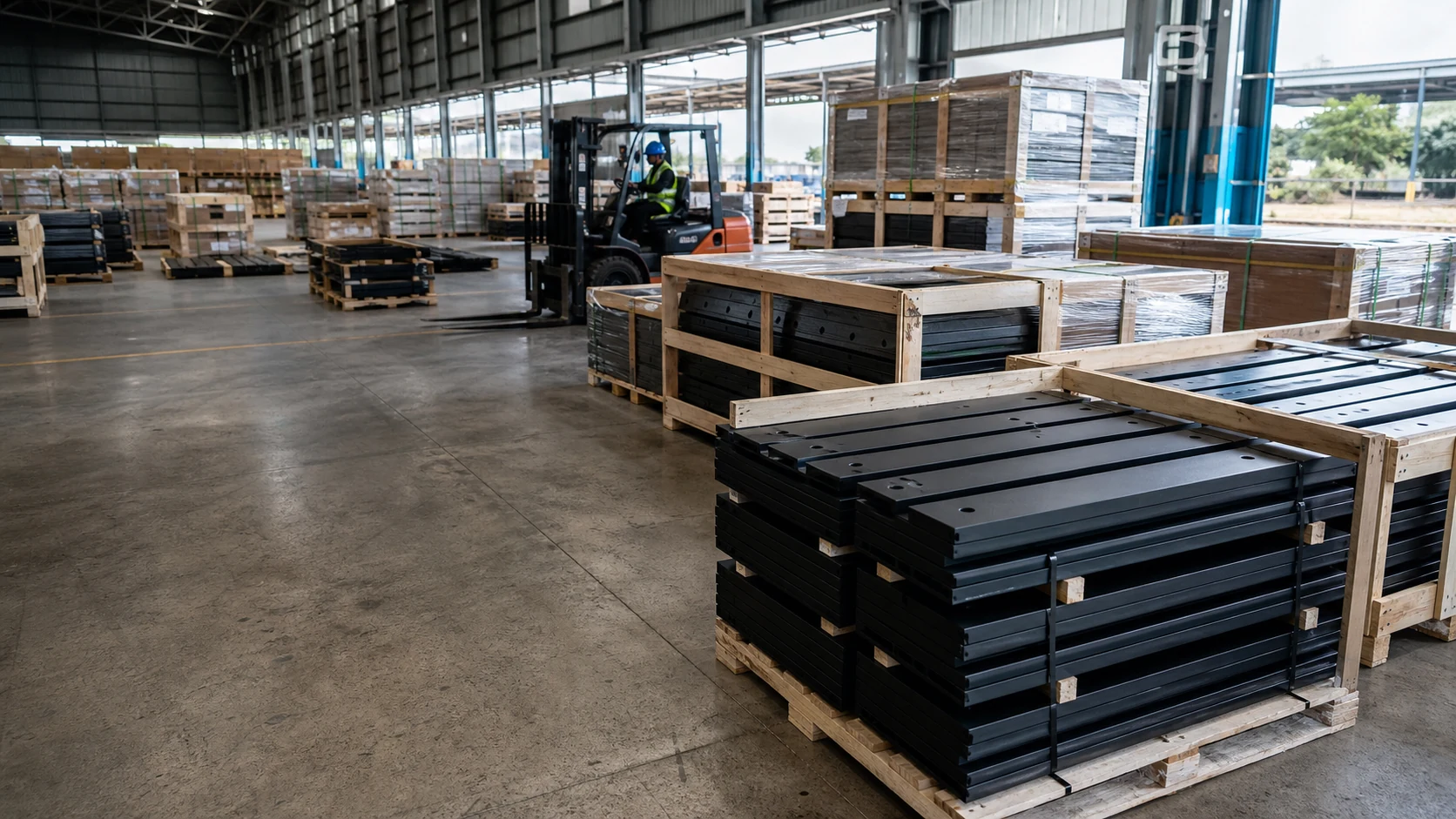 Sourcing carbide wear parts guideTechnical pack, supplier choice, landed cost and supply risk.Read the guide
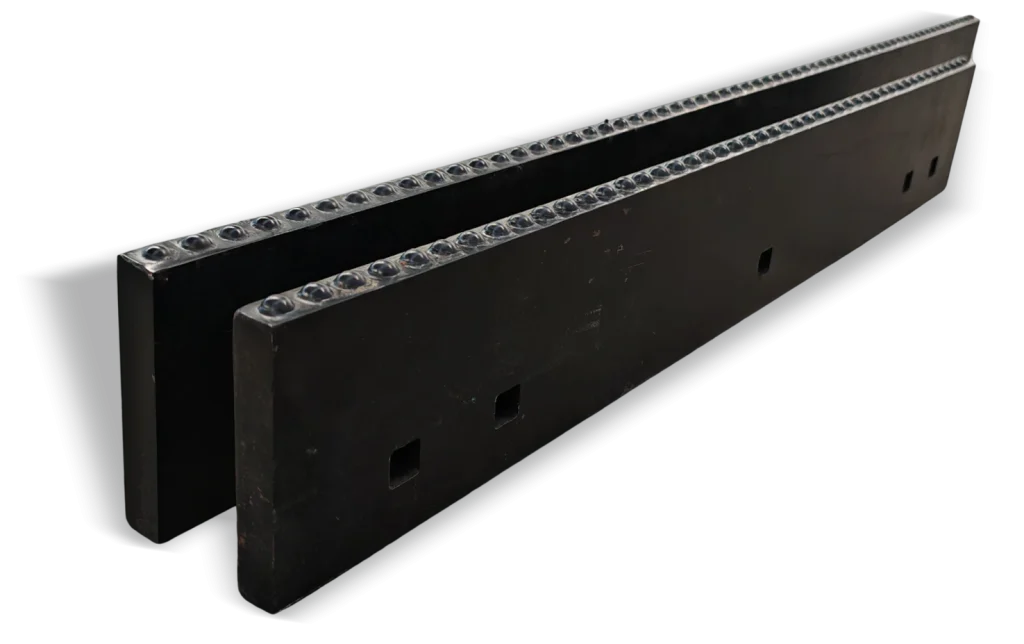 Packed ice edge guideWhy a standard edge skates, and how to make one bite.Read the guide
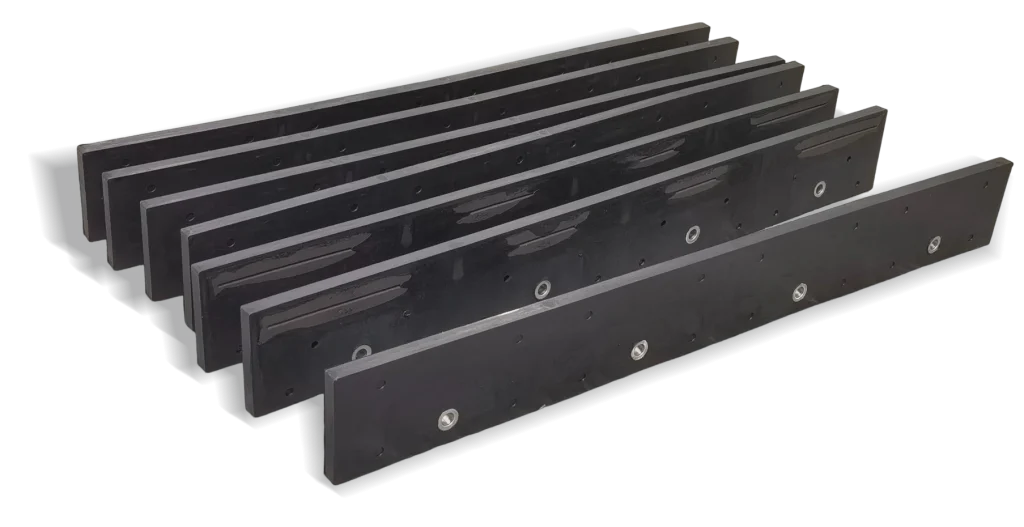 JOMA style rubber-flex blade guideSegments, clamps, insert retention and off-season care.Read the guide
 Talk to the quote deskSend the machine, the surface and a rough quantity.Request a quote