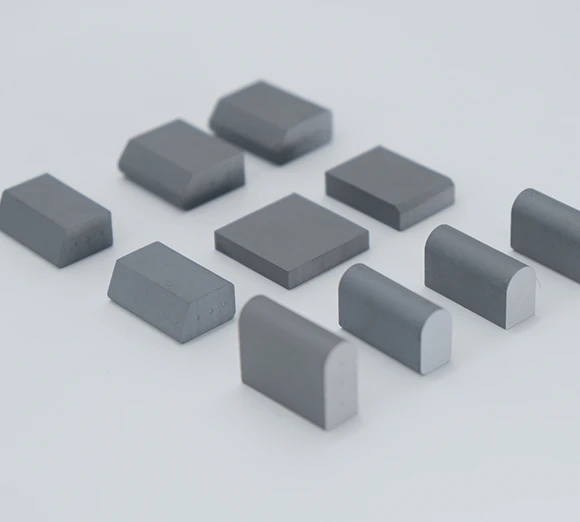
Check the ordered method and specimen requirement first. A coupon may be appropriate for a defined purpose, but its relationship to production must be documented and any departure from the agreed requirement approved. Do not assume that a convenient test piece is equivalent to a finished insert merely because the nominal grade matches.
Check what specimen the agreed method and contract require
Identify the property being tested, the applicable method and edition, the specimen form and the purchase acceptance clause. Ask whether the requirement concerns a production insert, a prepared specimen taken from it or a separately produced test piece. Those are different evidence routes, and the laboratory should identify which one its report will use.
ISO's hardmetal sampling and testing scope establishes that sampling and testing have defined procedures. Its public abstract does not grant permission to replace any finished-part specimen with a coupon. The qualified reviewer needs the actual applicable method and contract, not a general statement that coupons are common in laboratory work.
The hardness-method guide provides broader background. This decision is about specimen representativeness and authorization, not a universal rule either forbidding coupons or accepting them whenever testing the finished geometry is inconvenient.
Document how a coupon represents the production material and process
Ask how the proposed coupon relates to the production material and relevant process history. Identify material batch, production stage, preparation and any differences from the finished insert. The process owner should explain why those similarities and differences are appropriate to the property being assessed. A shared grade name is only one part of that explanation.
Keep the coupon drawing or description, identification and handling record with the proposed test plan. If a specimen is machined or prepared from a production insert, record its source and location. If it is made separately, say so clearly. Do not describe a separately prepared coupon as a random finished-part sample after the test is complete.
Ask what the result will not address. A material-property result may leave final dimensions, surface condition or assembly requirements outside its scope. NIST's metrology guidance supports careful interpretation of measurement evidence, but an accurately measured coupon is not automatically representative of every feature of the supplied part.
Get approval for any substitute specimen rather than assuming it is equivalent
If the proposed specimen differs from the agreed requirement, obtain the technical authority's disposition before using its result for acceptance. State whether the approval is for process qualification, lot acceptance, investigation or another defined purpose. Keep the affected order, quantity and conditions visible; approval of one coupon route should not silently authorize every future substitution.
Where the original method cannot be applied to the available finished geometry, ask the laboratory and specification owner to propose a valid route. Do not improvise specimen dimensions or relax the acceptance criterion simply to obtain a report. Historical Clear Roads research is further background, not a substitute specimen authorization for this contract.
For carbide insert orders, preserve the accepted specimen basis and reporting requirement with the material specification. Close the issue with a clear statement of what the test represents and what remains separately verified. That gives a coupon result its proper value without presenting it as evidence from a finished part that was never tested.
Sources and further reading. The ordered specification and applicable equipment documentation control acceptance and service decisions.
Clear Roads 17-02: Standard Specifications for Plow Blades with Carbide Inserts (historical research; not a universal specification) ↗NIST Metrological Traceability: FAQ and Policy ↗ISO 4489:2019: hardmetal sampling and testing scope ↗


