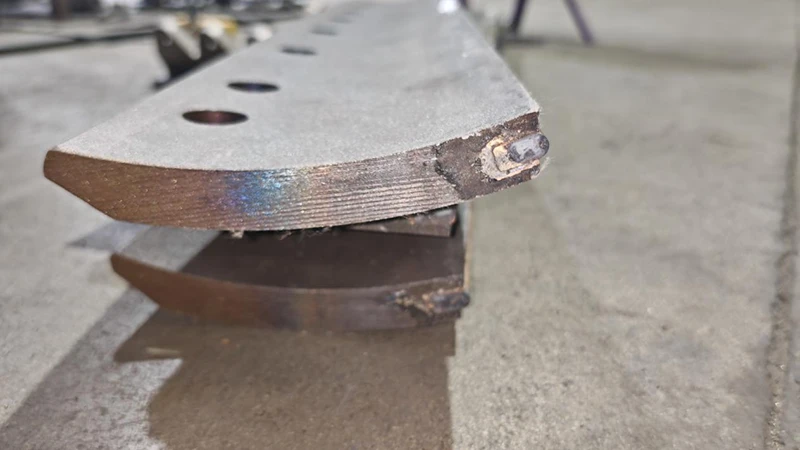
Send the worn sample with machine identification, mounting photographs, measured dimensions and a description of its service conditions. Mark what is worn, bent or uncertain. The aim is to establish a proposed specification for approval, rather than reproduce every feature of a damaged part.
Record what the worn sample can reliably show
It helps to organise the enquiry around three questions: what can still be measured reliably, what the replacement must connect to, and what performance problem the buyer wants to solve. These are related, but they need different evidence. A clear photograph can establish orientation without establishing a precise tolerance, while a machine document may identify a mounting requirement that the worn blade no longer shows.
Give the sample a reference label and photograph both faces, both ends, the mounting holes and the working edge. Include a scale in close-ups and state the units. Number the photos so a dimension can be traced to a location. Where possible, measure from a sound mounting reference rather than the worn cutting edge.
Record overall length, remaining height and thickness, hole positions and shapes, and any visible markings. Identify elongated holes, chipped areas, missing inserts, distortion or previous repairs. Describe the measuring method and any access limitation; do not supply a guessed original height as though it were measured.
Add machine and service-condition evidence
Include the plow or attachment make, model and identification plate, plus the old part number if available. Photograph the mounting assembly separately when it can be accessed safely. State whether the sample performed acceptably before it wore out, or whether the new part is meant to address a specific problem.
Describe the surface mix, typical obstacles and the operating setup you can verify. If the carbide grade or joining method is unknown, say so. Colour, appearance and remaining thickness cannot establish the original material specification or prove that a proposed substitute will perform the same way.
Agree a proposed drawing and approval step
Ask for a proposed drawing that distinguishes confirmed dimensions from reconstructed or assumed features. Resolve those assumptions with equipment records, another sound part or an agreed first article before production. Keep the sample label and photographs tied to that drawing.
A sample-fit check can answer the mounting question; a field trial addresses performance under the conditions tested. Specify which approval is being requested at each stage. The custom manufacturing page describes a route from an application brief through a proposed specification and sample to an approved production drawing.
A useful sample enquiry pack:
- Sample label, machine identification and existing part number, if known.
- Overall and close-up photographs with scale, orientation and units.
- Measured dimensions with worn or uncertain features clearly flagged.
- Mounting photographs and relevant equipment documentation.
- Surface conditions, the problem to solve, required quantity and delivery destination.
- A request to identify assumptions and proposed deviations before sample approval.
If two samples are available, keep their identities separate rather than combining their dimensions into one apparently complete part. They may represent different revisions or different wear histories. Explain why each reference was included, and ask the supplier to flag conflicts. The next useful deliverable is a proposed specification with visible open points and a clear approval step. It need not pretend that the original drawing has been recovered.
A worn sample can conceal its original height, edge angle, material grade or prior modifications. These gaps need explicit resolution. No drawing should be described as an exact original specification solely because it was measured from a used part.
Sources and further reading. Use the applicable equipment manual and approved specification for operating and installation requirements. Model-specific examples do not establish compatibility with another machine.
Sourcing carbide wear parts guide ↗Custom blade manufacturing ↗Carbide inserts ↗Snow plow blade selection guide ↗


